Ajanta and Ellora Caves: A Visitor Guide to the Cave Temples
The Ajanta and Ellora Caves are two groups of rock-cut temples and monasteries in Maharashtra, western India. Both have been UNESCO World Heritage Sites since 1983. Ajanta holds some of the finest surviving ancient Indian paintings. Ellora is famous for the Kailasa Temple, a whole temple carved down into a single hill. See our free photos of Ajanta and Ellora for a preview.
The two sites lie about 100 km apart, on different sides of Chhatrapati Sambhajinagar, the city still widely known as Aurangabad. Ellora is about 30 km from the city, while Ajanta takes around three hours by road. Here are the 10 best things to do at the Ajanta and Ellora Caves, with tips on when to go and how to plan your trip.
1. Walk around the Kailasa Temple at Ellora
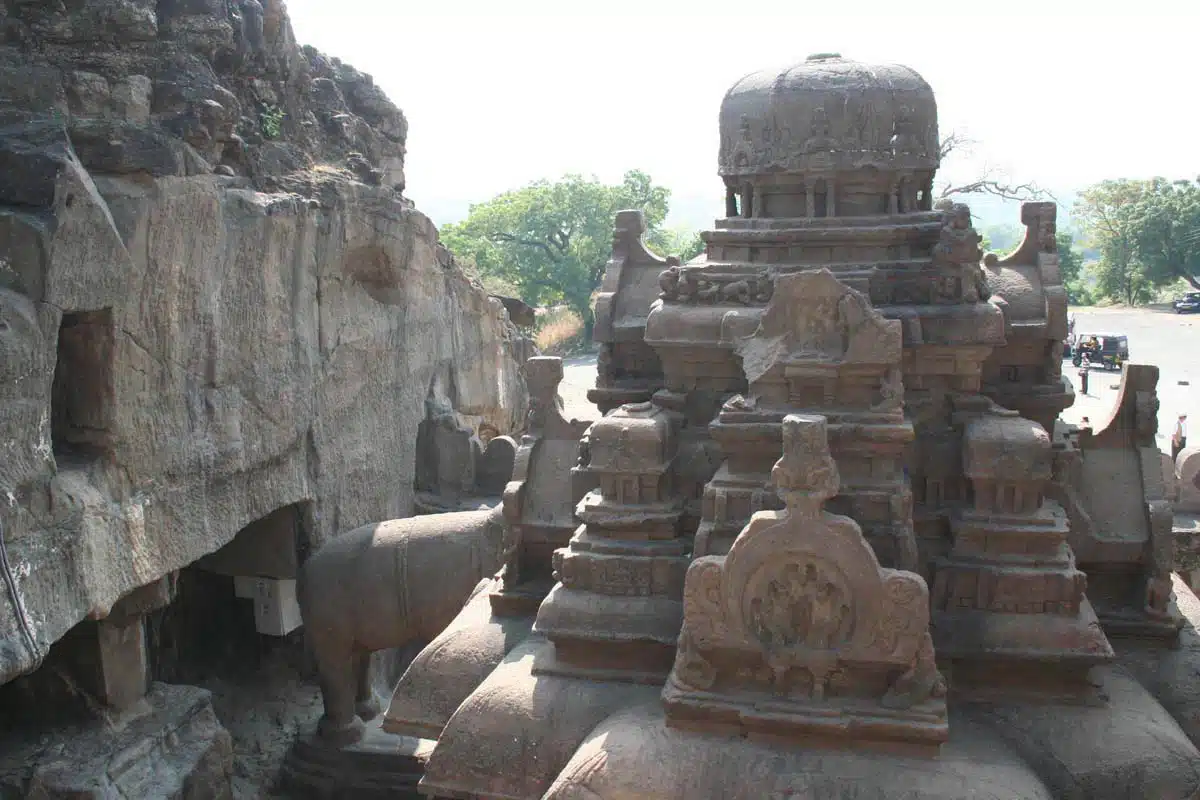
Cave 16, the Kailasa Temple, is the reason most people come to Ellora. In the 8th century, workers under the Rashtrakuta king Krishna I cut it downwards from the top of a basalt hill. The temple, its towers, its bridges and its life-size stone elephants are all one piece of rock. It is dedicated to Shiva and represents his home, Mount Kailash. Walk around the courtyard, then study the side walls, where carved panels tell stories from the Ramayana and the Mahabharata.
2. See the Kailasa Temple from above

A path climbs around the edge of the rock cut to the hill above the Kailasa Temple. From the top you look straight down onto the roof, the tower and the small rooftop shrines. You also get a real sense of how much rock was taken away. The walk is short but uneven. The light is softest in the morning or late afternoon.
3. Explore the Buddhist caves at Ellora
Caves 1 to 12, at the southern end of Ellora, are Buddhist and the oldest on the site. Do not miss Cave 10, the Vishwakarma Cave, a prayer hall with a large seated Buddha in front of a stupa. Its ribbed ceiling is carved to look like wooden beams, which is why it is called the carpenter’s cave. Cave 12, known as Tin Tal, is a three-storey monastery with long pillared halls and rows of seated Buddhas on the top floor.
4. Visit the Hindu caves beyond Kailasa

Caves 13 to 29 are Hindu. Cave 15, the Dashavatara Cave, is a two-storey hall with strong reliefs of Shiva and Vishnu. Cave 21, the Rameshwar Cave, has finely carved river goddesses at its entrance. Further north, Cave 29, the Dhumar Lena, is a large pillared hall with huge guardian figures at its doors. In the monsoon a waterfall pours over the cliff close by.
5. Find the Jain caves at Ellora
Caves 30 to 34 sit apart from the rest, a little further north, so many visitors miss them. They come from the last phase of work at Ellora, around the 9th and 10th centuries. The highlight is Cave 32, the Indra Sabha. This two-storey cave temple has a small shrine cut free in its courtyard, a stone elephant and delicate figures of Jain saints. It is usually much quieter than the main caves.
6. Study the paintings in Ajanta’s monastery caves

Ajanta is a row of 30 caves cut into a horseshoe-shaped cliff above the Waghur River. Most of the famous murals date from the 5th century. They show the life of the Buddha and the Jataka tales about his earlier lives. Cave 1 has the well-known painting of the bodhisattva Padmapani holding a lotus. Caves 2, 16 and 17 also have large painted walls and ceilings. Lighting is kept low to protect the paint, and flash photography is not allowed.
7. See the prayer halls at Ajanta

Ajanta also has chaitya halls, which are long prayer halls with a stupa at the far end. Caves 9 and 10 are among the oldest, from around the 2nd and 1st centuries BCE, and are plainer in style. Cave 19 has a richly carved front and a stupa with a standing Buddha. Cave 26, near the end of the row, holds a large reclining Buddha that shows his passing into nirvana, with his mourning followers carved below.
8. Walk to the Ajanta viewpoint
A path crosses the Waghur River and climbs to a viewpoint on the far side of the gorge. From here you see the whole curve of the cliff, with the cave entrances in a line. A British officer, John Smith, came across the caves in 1819 while hunting a tiger. In the monsoon, small waterfalls run down the rocks. Carry water for the climb.
9. Visit the Grishneshwar Temple
The Grishneshwar Temple stands close to the Ellora Caves, in the village of Verul. It is one of the 12 Jyotirlinga shrines of Shiva and an active place of pilgrimage. The red stone temple you see today was rebuilt in the 18th century under the Maratha queen Ahilyabai Holkar. Expect queues on Mondays and festival days. Dress modestly and follow the temple’s rules on photography.
10. Climb Daulatabad Fort
Daulatabad Fort, once called Devagiri, sits on a steep hill on the road between the city and Ellora, so it fits into an Ellora day. The Yadava kings built the first fortress. In the 14th century, Sultan Muhammad bin Tughluq briefly moved his capital here from Delhi. On the way up you pass the tall Chand Minar, moats and a dark tunnel. It is hard work in the heat, so start early.
When to visit the Ajanta and Ellora Caves
The most comfortable months are October to March, when days are warm and dry and nights are cool. This is also the busiest season, so arrive early. The monsoon, from around June to September, turns the hills green and brings waterfalls to the Ajanta gorge and Ellora’s northern caves. Paths can be slippery then. April and May are very hot, so visit early in the day. Remember that Ajanta is closed on Mondays and Ellora on Tuesdays.
Tips for planning your trip
Chhatrapati Sambhajinagar is the usual base, with domestic flights and trains from Mumbai. Most visitors hire a car with a driver, though buses and tours also run. At Ajanta, private vehicles stop at the T-point near Fardapur, and shuttle buses take you the last stretch to the caves. Tickets are sold at the entrance, and the Archaeological Survey of India also sells them online. In the city, Bibi Ka Maqbara, a 17th-century tomb modelled on the Taj Mahal, fills a spare hour. You can see more of the country in our India pictures. Carry water and a hat. Check your government’s current travel advice and India’s visa rules before you go.
Questions about the Ajanta and Ellora Caves
Can you see Ajanta and Ellora in one day?
It is possible but rushed, as the sites are about 100 km apart. Two days, one for each site, is much better.
Which is better, Ajanta or Ellora?
Ajanta is best for ancient paintings and its gorge setting, while Ellora is best for sculpture and the Kailasa Temple. Ellora is closer to the city, so it is easier if you only have time for one.
How long do you need at each site?
Allow at least half a day at each, plus travel. Ellora can easily fill a whole day.


