Things to Do in Vientiane: 11 Best Sights and Experiences

Vientiane sits on a wide bend of the Mekong River, with Thailand on the far bank. It’s one of the calmest capitals in Asia. The city is small and easy to get around, and it mixes gold Buddhist temples, old French buildings and busy morning markets. It’s also the main gateway to Laos by air, rail and road.
Most travellers spend a day or two here on the way to Luang Prabang or Vang Vieng. That’s enough for the main sights, but staying longer lets you settle into the slow pace, the riverside sunsets and the good food. Browse our free photos of Laos to get a feel for the city. Here are the 11 best things to do in Vientiane, with tips on when to go and how to plan your trip.
1. Pha That Luang, the golden stupa
Pha That Luang is the national symbol of Laos and appears on the country’s emblem. King Setthathirath built it in the 16th century after he moved the royal capital here from Luang Prabang. Invaders damaged it in later centuries and it was restored in the 20th century. The gilded stupa stands in a walled cloister, and there are temples on either side, including one with a large reclining Buddha. You need a ticket to enter the cloister. Go early or late in the afternoon, when the gold glows and the heat is lower.
2. Patuxai, the victory gate
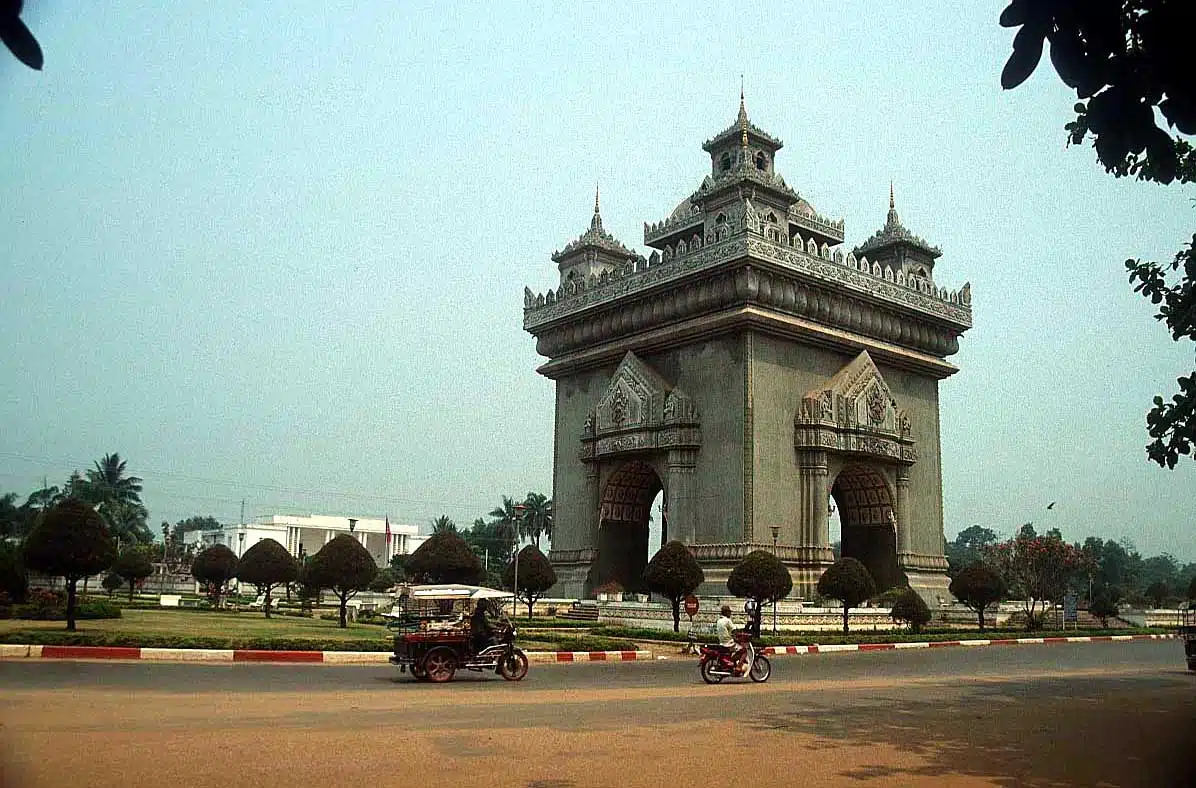
The Patuxai is a large concrete arch that honours those who fought for the country’s independence. It looks a little like the Arc de Triomphe, but the decoration is Lao, with Buddhist figures and mythical creatures under the arches. The concrete is often said to have been meant for an airport runway, which is why locals joke that the gate is a “vertical runway”. There is a small park with fountains around the base. Stairs inside lead up past souvenir stalls to viewing levels, and you need a ticket to go up.
3. Lane Xang Avenue and the Presidential Palace

From the top of the Patuxai you look straight down Lane Xang Avenue, Vientiane’s grand boulevard. At the far end stands the Presidential Palace, a large building in French Beaux-Arts style that is used for state functions and is not open to visitors. You can walk the avenue from the gate towards the river in about half an hour. On the way you pass the Talat Sao market, ministries and government buildings. Walk it in the morning, as there is little shade at midday.
4. Wat Si Saket and its thousands of Buddhas
Wat Si Saket was built in the early 19th century under King Anouvong. It is often called the oldest temple still standing in the city, because it survived when the Siamese army sacked Vientiane in the 1820s. The cloister walls hold thousands of small Buddha images in niches, with rows of larger seated Buddhas below them. Inside the main hall you can see old murals, but photography is not allowed there. You need a ticket. The temple is opposite the Presidential Palace, so it pairs easily with the next stop.
5. Haw Phra Kaew
Across the road from Wat Si Saket, Haw Phra Kaew was built as a royal temple to house the Emerald Buddha. The Siamese took that statue to Bangkok in the 18th century, where it remains today. The building was later reconstructed and now works as a small museum of religious art. It holds bronze Buddhas, carved doors and stone inscriptions, and the gardens around it are quiet and shaded. You need a ticket. Allow under an hour, and dress modestly as you would for a working temple.
6. The city temples of the old centre

The streets between the river and Setthathirath Road are full of active monasteries, including Wat Ong Teu, Wat Mixay, Wat Inpeng and Wat Haysoke. Monks live and study in many of them, and visitors are welcome to look around the grounds. A little further out, Wat Si Muang holds the city pillar, and locals come there to ask for blessings. Cover your shoulders and knees, take off your shoes before entering a hall, and never point your feet at a Buddha image.
7. That Dam, the Black Stupa
That Dam is an old, dark brick stupa standing in a small roundabout among embassies and cafés. Unlike the gilded temples, it has weathered to a mossy grey-black colour. Local legend says a seven-headed naga, a mythical serpent, lives inside and once protected the city. There is nothing to buy and no ticket. It takes five minutes to see, but it’s an easy stop on a walk through the centre. Many good cafés and bakeries are close by.
8. COPE Visitor Centre
During the Vietnam War, Laos became the most heavily bombed country per person in history, and unexploded bombs still injure people today. The COPE Visitor Centre explains this history and the work of supporting people who have lost limbs. It covers the clearance of unexploded ordnance (UXO) and the making of artificial limbs. The exhibits are clear, moving and suitable for older children. The centre is in the grounds of the national rehabilitation centre. Donations and shop purchases support its work.
9. Mekong riverside and the night market
In the late afternoon, locals head to Chao Anouvong Park on the Mekong. A large statue of King Anouvong faces Thailand across the water. As the sun goes down, groups do outdoor aerobics and families walk along the promenade. A night market of red-roofed stalls sets up along the riverside in the evening, selling clothes, bags and souvenirs. Food stalls nearby grill fish and meat. It’s the best place in the city to watch the sunset.
10. Street food and Lao cafés

Eating is one of the best things to do in Vientiane. Try laap, a spicy minced meat salad, with sticky rice, and khao piak sen, a thick rice noodle soup sold for breakfast. Look out too for green papaya salad and grilled chicken from roadside stalls. French influence lives on in baguette sandwiches filled with pâté and herbs, and in a strong coffee culture. Browse the stalls at Talat Sao or the smaller local markets in the morning. In the evening, have a cold Beerlao by the river.
11. Day trip to Buddha Park (Xieng Khuan)
About 25 km south-east of the centre, near the Friendship Bridge to Thailand, Buddha Park is a riverside garden of more than 200 concrete statues. A monk and mystic began it in the 1950s, mixing Buddhist and Hindu figures. The best-known statues are a huge reclining Buddha and a round, pumpkin-shaped tower you can climb inside for views. You need a ticket. Local buses run there from the central bus station near Talat Sao, or you can hire a tuk-tuk for the round trip.
When to visit Vientiane
The best time to visit Vientiane is the dry, cooler season from November to February. Days are warm and sunny and the evenings are pleasant by the river. March to May is very hot, and the rainy season usually runs from about May to October. The rains bring short heavy downpours, green countryside and fewer visitors. If you can, plan around the That Luang Festival in November, when crowds of pilgrims, processions and a large fair fill the area around the stupa. Boat races on the Mekong usually mark the end of Buddhist Lent in October. Festival dates follow the lunar calendar and change each year.
Tips for planning your trip
Wattay International Airport is close to the city and has flights from Bangkok, Hanoi and other regional hubs. If you’re coming from Vietnam, see our Hanoi travel tips. Overland, the Friendship Bridge links Vientiane with Nong Khai in Thailand. The Lao-China Railway runs from a station on the edge of the city to Vang Vieng and Luang Prabang. Book train tickets in advance and carry your passport, because it’s checked when you buy and when you board. Our guide to things to do in Luang Prabang covers the next stop for most travellers. In the city, the centre is easy to walk early and late in the day. For longer trips, take a tuk-tuk (agree the fare first) or use a local ride-hailing app. Bicycles are also easy to hire. Two full days are enough for the main sights. Visa rules for Laos depend on your nationality, so check your government’s current travel advice before you go.
Questions about Vientiane
Is Vientiane worth visiting?
Yes, especially for a day or two. It’s relaxed, easy to explore and has some of the most important monuments in Laos, including Pha That Luang, plus very good food.
How many days do you need in Vientiane?
Two days let you see the main temples, the Patuxai, COPE and the riverside without rushing. Add a day for Buddha Park or a slower pace.
How do you get from Vientiane to Luang Prabang?
The quickest way overland is the Lao-China Railway, which takes a few hours. Book ahead and bring your passport. There are also flights and long-distance buses.


