Things to Do in Luxembourg City: 12 Best Sights and Experiences

Luxembourg City is the capital of the Grand Duchy of Luxembourg, a small country between Belgium, France and Germany. Its old town sits on a rocky plateau above the deep valleys of the Alzette and Pétrusse rivers, and the remains of a huge fortress still surround it. The old quarters and fortifications are a UNESCO World Heritage Site, and you can walk across most of the centre in a day.
The city mixes medieval lanes, underground tunnels, quiet river quarters and the glass towers of the EU institutions on the Kirchberg plateau. Public transport is free, so getting around is easy. To get a feel for the place before you go, browse our free photos of Luxembourg City. Here are the 12 best things to do in Luxembourg City, with tips on when to go and how to plan your trip.
1. Place de la Constitution and the Gëlle Fra
This square stands on an old bastion and is the classic first stop. It has a wide view over the Pétrusse valley and the Adolphe Bridge. At its centre is the Monument of Remembrance, known as the Gëlle Fra or Golden Lady. It was put up in 1923 for the Luxembourgers who died in the First World War. The Nazi occupiers pulled it down in 1940, and it was later restored. Today it is a symbol of freedom and resistance.
2. Go underground in the Bock and Pétrusse Casemates
Count Siegfried built a castle on the Bock promontory in 963, and the city grew from there. Later rulers dug kilometres of defensive tunnels into the rock. You can visit two sections today. The Bock Casemates on Montée de Clausen were built by the Austrians in the 18th century and include an archaeological crypt. The Pétrusse Casemates beside the Gëlle Fra can be seen on guided tours with light and sound installations. Tickets have time slots, so book ahead in busy months.
3. Walk the Chemin de la Corniche
This footpath runs along the old ramparts from the Bock towards the Saint-Esprit plateau. People often call it the most beautiful balcony in Europe. Below you are the roofs of the Grund, the Alzette river, Neumünster Abbey and the fortress walls on the far side of the valley. The walk is short, flat and free. Go early in the morning or near sunset for softer light and fewer people. It also links up well with the Wenzel Circular Walk through the old quarters.
4. Wander through the Grund

The Grund is the old riverside quarter at the foot of the cliffs. Its stone houses, small bridges and pubs make it a good place to slow down. Neumünster Abbey was once an abbey and later a prison. Today it is a cultural centre with concerts, exhibitions and a café terrace. You can walk down from the Corniche, or take the free public lift from the Saint-Esprit plateau. Save some energy for the climb back up if you walk.
5. Visit Notre-Dame Cathedral

The cathedral’s slim spires are a landmark of the skyline. It was built as a Jesuit church in the early 17th century and became a cathedral in the 19th century. The building is late Gothic with Renaissance details. The crypt holds the tomb of John the Blind, Count of Luxembourg and King of Bohemia, and the burial vault of the grand ducal family. In spring, the Octave pilgrimage brings large crowds from across the country.
6. See the Grand Ducal Palace and Place Guillaume II
The Grand Ducal Palace on Rue du Marché-aux-Herbes is the town residence of the grand ducal family. It has a richly decorated 16th-century facade. You can only go inside on guided tours in summer, roughly from mid-July to the end of August. Book these through the Luxembourg City Tourist Office. The office is close by on Place Guillaume II, a large square with the city hall and an equestrian statue. It is a good place to start your visit.
7. Cross the Adolphe Bridge and walk the Pétrusse valley
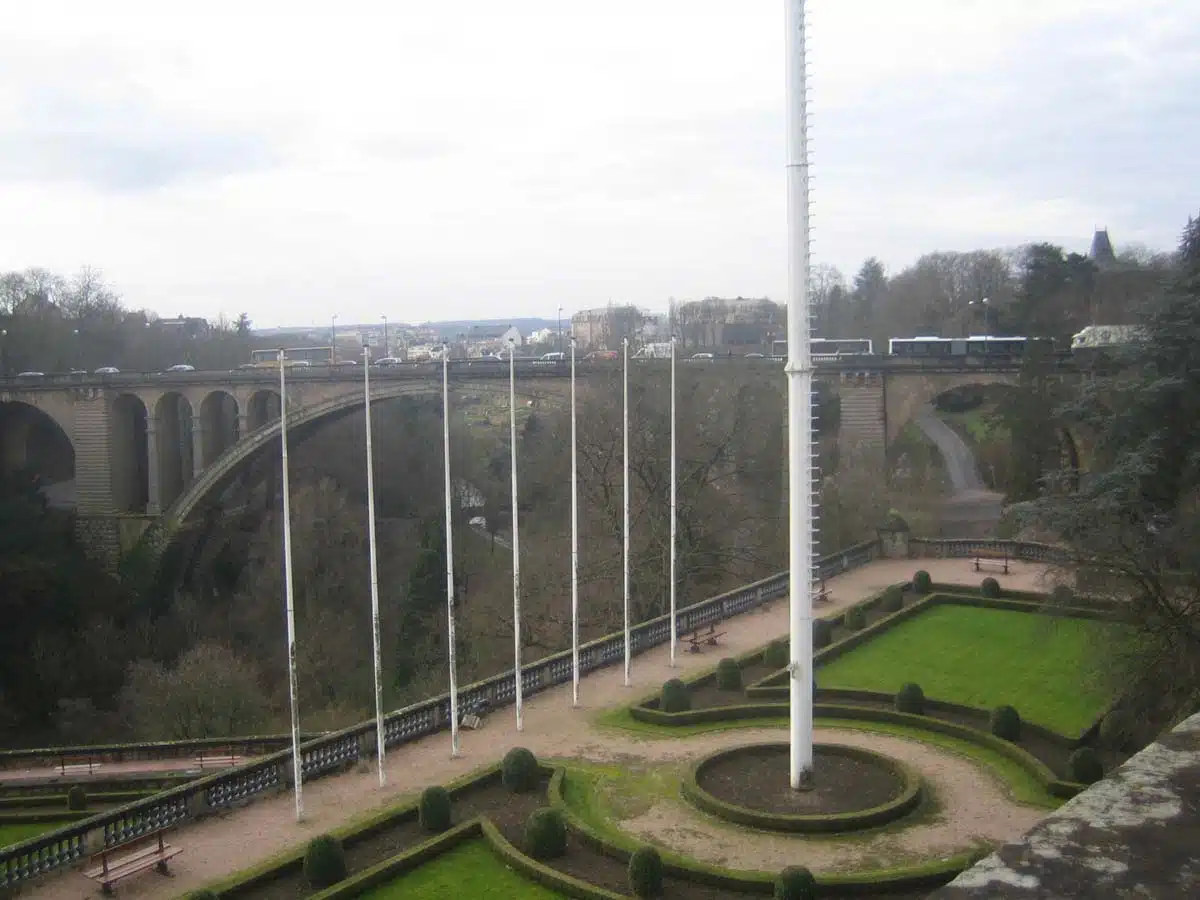
The Adolphe Bridge is a large stone arch, opened in the early 1900s, that links the old town with the station district. A walkway for pedestrians and cyclists hangs under the road deck and gives good views along the valley. Below the bridge, the Pétrusse valley is a long green park with paths, lawns and a small stream. Stairs lead down from near Place de la Constitution, so you can easily add a loop on foot.
8. Learn the city’s story in its museums
Two good museums are close together in the oldest part of town. The Lëtzebuerg City Museum tells the story of the city from its beginnings to today and includes models of the old fortress. The National Museum of Archaeology, History and Art is on the Marché-aux-Poissons. Its collections range from Roman finds to fine art. Both are good choices on a rainy day. Opening days vary, so check before you go.
9. Ride the Pfaffenthal lift
This free glass lift runs from Pescatore park in the upper town down to the Pfaffenthal quarter in the Alzette valley. The views over the valley and the red Grand Duchess Charlotte Bridge make the ride worthwhile, even if you only go down and come straight back up. At the bottom, cross the valley on foot to the Pfaffenthal-Kirchberg funicular. It climbs to the tram stop on the Kirchberg plateau, so it makes a good route to the next stop.
10. Discover modern Kirchberg
Kirchberg is across the red bridge. EU institutions such as the European Court of Justice and the European Investment Bank are based here, and the area has some of the city’s best modern architecture. Mudam, the museum of modern art designed by I. M. Pei, stands next to Fort Thüngen. The fort, known for its three towers, holds the Dräi Eechelen museum about the fortress and the country’s history. The Philharmonie, with its white columns, holds concerts through much of the year.
11. Relax in the Municipal Park and Villa Vauban

Most of the fortress was taken down after 1867, and parts of the old defences became green space. The Municipal Park curves around the west side of the old town, with shady paths, lawns and play areas. Villa Vauban, the city’s art museum, stands inside the park. It shows European paintings from the 17th to the 19th century, along with changing exhibitions. The park is a quiet break from the busy shopping streets nearby.
12. Take a day trip into the countryside
Luxembourg is small and public transport is free, so day trips are easy. In the north, Vianden has a large restored castle on a hill above the Our river. The Mullerthal region near Echternach is known for sandstone rocks, forests and the long-distance Mullerthal Trail. To the south-east, the Moselle valley has wine villages and the town of Schengen, where the Schengen Agreement was signed. Plan your connections in advance, because some rural buses run less often.
When to visit Luxembourg City
Late spring to early autumn is the best time to visit. The days are long for walking the valleys, and café terraces are open in the Grund. July and August bring the summer palace tours and more visitors. National Day is on 23 June, and the celebrations start the evening before with fireworks. The Schueberfouer funfair fills the Glacis square from late August into September. The Winterlights Christmas markets open in late November. Winter is often cold and grey, but the city is quieter, and the valleys look lovely after snow.
Tips for planning your trip
Luxembourg Airport is about 6 km from the centre, around 15 minutes by tram or bus. Direct trains link the city with Brussels, Paris (by TGV), Metz and Trier. Buses, trams and second-class trains are free across the whole country, and you do not need a ticket. The old town is small but hilly, so wear good shoes and use the free lifts between the upper town and the valleys. One full day is enough for the main sights. Two or three days give you time for the casemates, museums, Kirchberg and a day trip. Book casemate tickets and summer palace tours ahead through the tourist office.
Questions about Luxembourg City
Is public transport really free in Luxembourg City?
Yes. Since 2020, buses, trams and second-class trains have been free for everyone across Luxembourg, including tourists, so you don’t need a ticket.
How many days do you need in Luxembourg City?
One full day covers the old town, the Corniche and the Grund. Two or three days let you visit the casemates and museums, explore Kirchberg and take a day trip.
Can you visit the inside of the Grand Ducal Palace?
Only on guided tours in summer, roughly from mid-July to the end of August. Book a place through the Luxembourg City Tourist Office, because places are limited.


