Things to Do in Kraków: 12 Best Sights and Experiences

Kraków is the former royal capital of Poland, on the River Vistula in the south of the country. Its medieval Old Town, Wawel Hill and the old Jewish quarter of Kazimierz were among the first places UNESCO listed in 1978. The centre survived the Second World War largely intact.
The city is also the base for day trips to the Wieliczka Salt Mine and the Auschwitz-Birkenau Memorial. Browse our free photos of Kraków. Here are the 12 best things to do in Kraków, with tips on when to go and how to plan your trip.
1. Main Market Square and the Cloth Hall
Rynek Główny was laid out in 1257 and is one of the largest medieval squares in Europe. In the middle stands the Cloth Hall (Sukiennice), with craft and amber stalls on the ground floor and a gallery of 19th century Polish art upstairs. Nearby stand the Town Hall Tower and a statue of Adam Mickiewicz. Horse carriages wait for passengers, and the cafés are good for people watching.
2. St Mary’s Basilica and the hourly trumpet call
The two unequal brick towers of St Mary’s Basilica rise over the square. Inside is the carved Gothic altarpiece by Veit Stoss, made between 1477 and 1489. Tourists need a ticket and use a separate entrance. Every hour a trumpeter plays the hejnał from the taller tower and stops mid-note, recalling a watchman said to have been shot by an arrow. In the warmer months you can climb that tower, but places are limited.
3. Rynek Underground
Beneath the square, the Rynek Underground museum leads you along medieval street levels uncovered by archaeologists. Glass walkways, old market stalls, coins and multimedia displays show how Kraków grew into a rich merchant city. It is run by the Museum of Kraków and entry is by timed ticket, so book online in summer.
4. Floriańska Street, St Florian’s Gate and the Barbican

Floriańska Street runs from the square to St Florian’s Gate, one of the few surviving parts of the medieval walls. Just outside stands the Barbican, a round brick fortification from the late 15th century. This is the start of the Royal Route that kings followed to Wawel. The Planty park circles the Old Town where the walls once stood. On Franciszkańska Street, look up at the Papal Window, where Pope John Paul II spoke to crowds.
5. Wawel Royal Castle

On a limestone hill above the river, Wawel was the seat of Polish kings for centuries. You can walk onto the hill and into the arcaded Renaissance courtyard without a ticket. The exhibitions have separate timed tickets. They include the State Rooms with their Flemish tapestries, the Crown Treasury and Armoury, and The Lost Wawel underground. Popular slots go early in summer, so buy them on the castle’s official website.
6. Wawel Cathedral

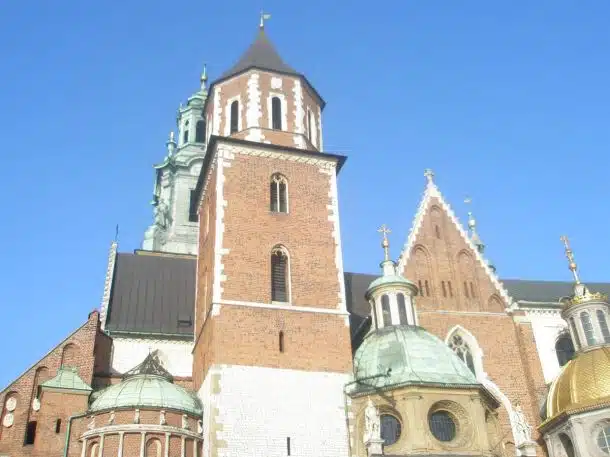
Polish kings were crowned and buried in Wawel Cathedral. Look for the gilded dome of the Sigismund Chapel, one of the finest Renaissance chapels north of the Alps. Cathedral tickets are sold separately from castle tickets and cover the Royal Tombs, the climb to the great Sigismund Bell and the Cathedral Museum. The crypts also hold the poets Adam Mickiewicz and Juliusz Słowacki. Tourist visits are limited during services.
7. Dragon’s Den and the Vistula riverside
Legend says a dragon lived in a cave under Wawel Hill until a clever shoemaker tricked it. Walk down through the Dragon’s Den (Smocza Jama), a short limestone cave, and come out on the riverbank beside a metal dragon statue that breathes fire. The cave opens only in the warmer months and needs a small ticket. From there, riverside paths lead to Kazimierz.
8. Kazimierz: streets and synagogues
King Casimir the Great founded Kazimierz as a separate town in the 14th century, and for centuries it was the heart of Jewish life in Kraków. Start on Szeroka Street, then visit the Old Synagogue, the oldest surviving synagogue building in Poland and now a branch of the Museum of Kraków. In the evening, Plac Nowy, with its round market hall and zapiekanka stalls, fills with locals and students.
9. Remuh Synagogue and the Old Jewish Cemetery

The small 16th century Remuh Synagogue on Szeroka Street is still used for worship. Behind it lies the Old Jewish Cemetery, founded in the 1530s and badly damaged during the German occupation. In 1959 hundreds of gravestones were found under the soil and set upright again, and broken fragments now form a moving wall. Men should cover their heads, and the site is closed on Saturdays and Jewish holidays.
10. Schindler’s Factory and Podgórze
Cross the Father Bernatek Footbridge to Podgórze, where the German occupiers set up the Kraków ghetto in 1941. At Oskar Schindler’s Enamel Factory, the Museum of Kraków tells the story of the city under occupation. Tickets are timed and often sell out, so book online well ahead. Nearby, Ghetto Heroes Square has a memorial of large empty chairs, and the Eagle Pharmacy museum stands on one corner.
11. Wieliczka Salt Mine
Just south-east of the city, the Wieliczka Salt Mine was worked for around 700 years and joined UNESCO’s first list in 1978. Guided tours lead down wooden stairs to chambers, underground lakes and the Chapel of St Kinga, where even the chandeliers are made of salt. Book a time in advance, especially in summer. It stays cool underground, so bring a layer. Trains and buses run from Kraków.
12. Auschwitz-Birkenau Memorial
The former German Nazi concentration and extermination camp near Oświęcim is now a memorial and museum. It is about an hour and a half west of Kraków by road. More than a million people were murdered here, most of them Jews. You need a personal entry card booked in advance on the memorial’s official website. Allow most of a day including travel. Visits are not recommended for children under 14.
When to visit Kraków
May, June, September and early October bring mild weather and fewer crowds than July and August. Summer is warm and busy, and Kazimierz hosts the Jewish Culture Festival each summer. In December a Christmas market fills the Main Market Square. Winter is cold and often snowy, but queues are shorter. In recent years the castle has offered free entry to selected exhibitions in November.
Tips for planning your trip
Trains run from Kraków’s John Paul II International Airport to Kraków Główny, the main station beside the Old Town. There are also direct trains from Warsaw. The Old Town, Wawel and Kazimierz are easy to walk, and trams cover longer trips. Plan three or four days: two for the city and one each for Wieliczka and Auschwitz. Book timed tickets for the big sights before you travel. Read our things to know before planning a trip to Poland, and check your government’s current travel advice before you go.
Questions about Kraków
How many days do you need in Kraków?
Two full days cover the Old Town, Wawel and Kazimierz. Add one day each for the Wieliczka Salt Mine and Auschwitz-Birkenau.
Can you visit Wawel for free?
You can walk on Wawel Hill and into the castle courtyard for free. The castle exhibitions and the cathedral’s tombs, bell and museum need tickets.
Can you see Wieliczka and Auschwitz on the same day?
Many tours combine them, but it is a long and emotionally heavy day. Separate days are better if you have time.