11 Famous Buddha Statues in Asia to Visit
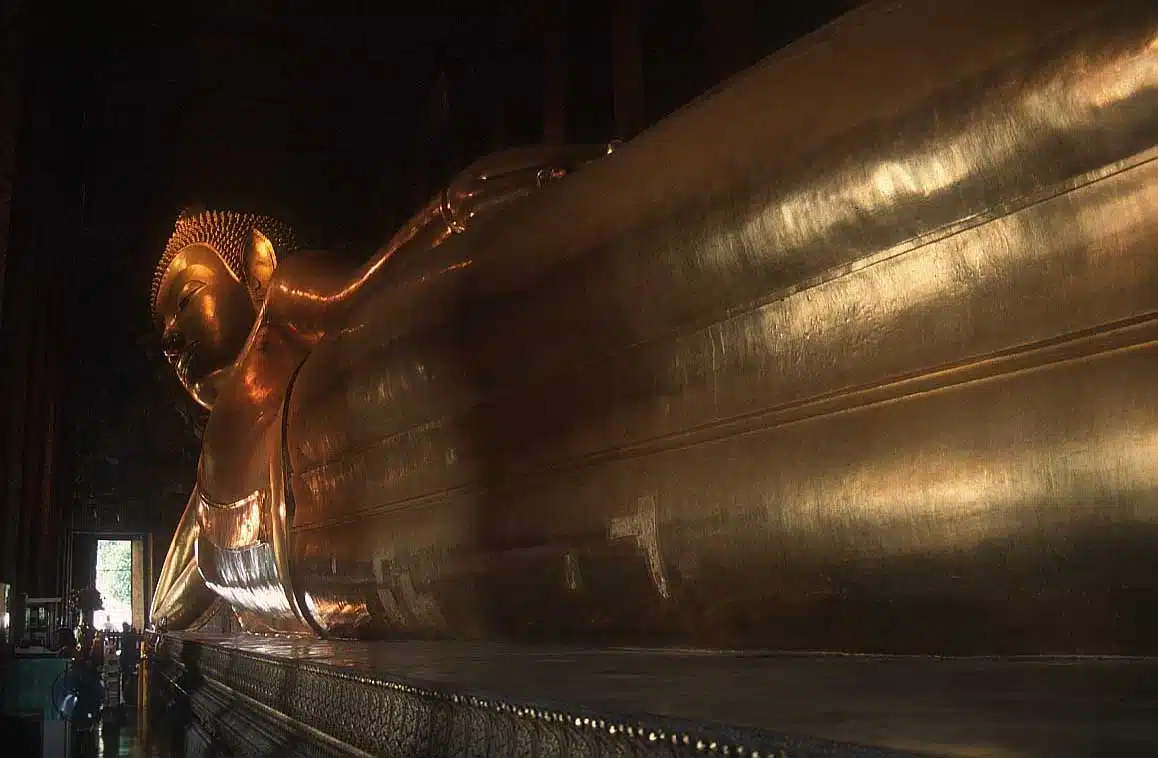
Asia has some of the largest and oldest Buddha statues in the world. This list covers the best known: gold-covered reclining Buddhas in Thailand, a huge bronze Buddha on a Hong Kong mountain top, and figures carved straight out of rock in India, China and Sri Lanka. Each one is a place of worship as well as a work of art. Many are also linked to long histories of kings, monks and pilgrims, and that history is a big part of why they are worth the trip.
The places are grouped by region, so you can plan a trip around two or three of them. Many of them appear in our free Buddha pictures, taken by our own photographers. Here are 11 of the most famous Buddha statues in Asia, with tips on visiting them.
1. Reclining Buddha at Wat Pho, Bangkok, Thailand
Wat Pho is one of Bangkok’s oldest temples. Its Reclining Buddha is 46 metres long and 15 metres high, and it almost fills its hall. The statue is covered in gold leaf. The soles of its feet are inlaid with mother-of-pearl, showing 108 symbols. The temple is also home to a well-known school of Thai massage. You need a ticket, and shoulders and knees must be covered. Take the river ferry to Tha Tien pier or the MRT to Sanam Chai, and arrive early to avoid the tour groups.
2. Wat Lokayasutharam, Ayutthaya, Thailand

Ayutthaya was the capital of Siam for four centuries. Today its ruins form a UNESCO World Heritage Site. At Wat Lokayasutharam, a brick and plaster Buddha 42 metres long lies in the open air, usually wrapped in a saffron cloth. Nearby temples have rows of headless seated Buddhas and brick prang towers. Ayutthaya is an easy day trip from Bangkok by train or minibus. Rent a bicycle or a tuk-tuk to get between the sites, and go early in the morning before the heat builds.
3. Temples of the Old City, Chiang Mai, Thailand

Chiang Mai’s walled Old City has dozens of temples within walking distance of each other. Wat Phra Singh keeps the Phra Buddha Sihing, a revered bronze image that is carried through the streets during the Songkran new year festival in April. Wat Chedi Luang has a huge ruined brick chedi. Many smaller temples have golden Buddhas in front of carved wooden altars. Start early, wear clothes that cover your shoulders and knees, and take off your shoes before going into a hall.
4. Wat Si Saket, Vientiane, Laos
Wat Si Saket was built in the early 19th century under King Anouvong. It is often described as the oldest temple still standing in Vientiane, as it survived when Siamese armies sacked the city in 1828. The cloister walls are lined with thousands of small Buddha images set in niches, with rows of larger seated Buddhas beneath them. It is a quiet place and easy to reach on foot from the riverside. You need a ticket, and modest dress is expected.
5. Tian Tan Buddha, Lantau Island, Hong Kong

The Tian Tan Buddha, also called the Big Buddha, is a 34-metre seated bronze statue finished in 1993. It sits on a hill at Ngong Ping next to Po Lin Monastery. You climb 268 steps to reach it, past bronze figures making offerings. Most visitors ride the Ngong Ping 360 cable car from Tung Chung. It sometimes closes for scheduled maintenance, so check before you go. If it is closed, take a bus from Tung Chung instead. Morning mist can hide the statue, so clear days give the best views.
6. Ajanta Caves, Maharashtra, India

Ajanta is a group of about 30 Buddhist caves cut into a horseshoe-shaped gorge. The work began around the 2nd century BCE, and the later caves date from the 5th century CE. The caves hold carved Buddhas, stupas in prayer halls and some of the finest ancient wall paintings in India, along with a large reclining Buddha. Ajanta is closed on Mondays. Cars stop at a visitor centre, and shuttle buses take you on to the caves. Our Ajanta and Ellora caves guide has more detail.
7. Ellora Caves, Maharashtra, India

Ellora has Buddhist, Hindu and Jain cave temples side by side, and caves 1 to 12 are Buddhist. Cave 10 is known as the Vishvakarma or Carpenter’s Cave. Its rock ceiling is carved to look like wooden beams, and a large seated Buddha sits in front of a stupa. Ellora is closed on Tuesdays, so you can visit Ellora and Ajanta on two days in a row. Both are reached from Chhatrapati Sambhajinagar, the city formerly called Aurangabad.
8. Leshan Giant Buddha, Sichuan, China
The Leshan Giant Buddha is a seated Buddha 71 metres tall, carved into a red sandstone cliff in the 8th century. It looks out over the meeting point of three rivers. Together with Mount Emei, it is a UNESCO World Heritage Site. It is one of the largest stone Buddhas in the world. You can walk down a steep cliff path beside the statue or see the whole figure from a tourist boat. Tickets are needed and the path can have long queues, so go early or avoid Chinese public holidays. Leshan is usually visited from Chengdu.
9. Great Buddha of Kamakura, Japan
The bronze Great Buddha at Kōtoku-in temple dates from the 13th century. It has sat in the open air since its hall was destroyed centuries ago. The calm, seated figure is one of the best-known images of Japan. For a small extra fee you can go inside the hollow statue and see how it was cast. Kamakura is an easy day trip from Tokyo. Take the Enoden line to Hase Station, then walk a few minutes to the temple.
10. Tōdai-ji, Nara, Japan
Tōdai-ji was founded in the 8th century. Its Daibutsuden hall holds a seated bronze Buddha about 15 metres high, and the hall itself is one of the largest wooden buildings in the world. Inside, children and adults try to squeeze through a hole in a wooden pillar that is said to be the size of the Buddha’s nostril. The temple is in Nara Park, where tame deer roam, and it is a walk from Nara’s train stations. You need a ticket for the Great Buddha Hall.
11. Gal Vihara, Polonnaruwa, Sri Lanka
Gal Vihara has four Buddha images carved into one granite rock face in the 12th century, under King Parakramabahu I. There are two seated Buddhas, a standing figure and a reclining Buddha about 14 metres long. Many people think it is the finest rock carving in Sri Lanka. It is part of the ancient city of Polonnaruwa, a UNESCO World Heritage Site, and you need a ticket for the whole site. Remove your shoes and hat, and do not pose for photos with your back to the Buddha.
Tips for visiting
Almost all of these statues are in active places of worship, so dress modestly with shoulders and knees covered. Take off your shoes and hat where asked. Never touch or climb on a Buddha image, and do not point your feet towards it. Go early in the morning for cooler weather, softer light and fewer crowds. Carry water and wear sandals you can slip off easily. Flash and tripods are not allowed in some halls and caves, especially near the paintings at Ajanta. Entry and visa rules differ between Thailand, Laos, China, India, Japan and Sri Lanka, so check your government’s current travel advice before you go.
Questions about famous Buddha statues in Asia
What is the largest Buddha statue in Asia?
On this list, the Leshan Giant Buddha in China is the largest at 71 metres tall. Some modern statues in Asia are taller, but Leshan is the largest ancient stone Buddha.
Can I take photos of Buddha statues?
Yes, at most temples, but some halls and caves do not allow photos, and you should follow the signs. Do not pose with your back to a statue or in a way that could look disrespectful.
What should I wear to visit a Buddhist temple?
Wear loose clothes that cover your shoulders and knees, and shoes that are easy to take off. Some temples, such as Wat Pho, lend or rent cover-ups at the entrance.


