10 Most Beautiful Madrasas, Mausoleums and Minarets of Uzbekistan
This guide covers the finest madrasas, mausoleums and minarets in the old Silk Road cities of Uzbekistan: Samarkand, Bukhara, Khiva and Shakhrisabz. Their rulers spent Silk Road wealth on turquoise domes, glazed tiles and patterned brick, and much of it still stands, as you can see in our free Islamic architecture pictures.
The cities are linked by fast trains, and some sights are still places of prayer and pilgrimage. Here are 10 of the most beautiful madrasas, mausoleums and minarets in Uzbekistan, with tips on visiting them.
1. Registan, Samarkand
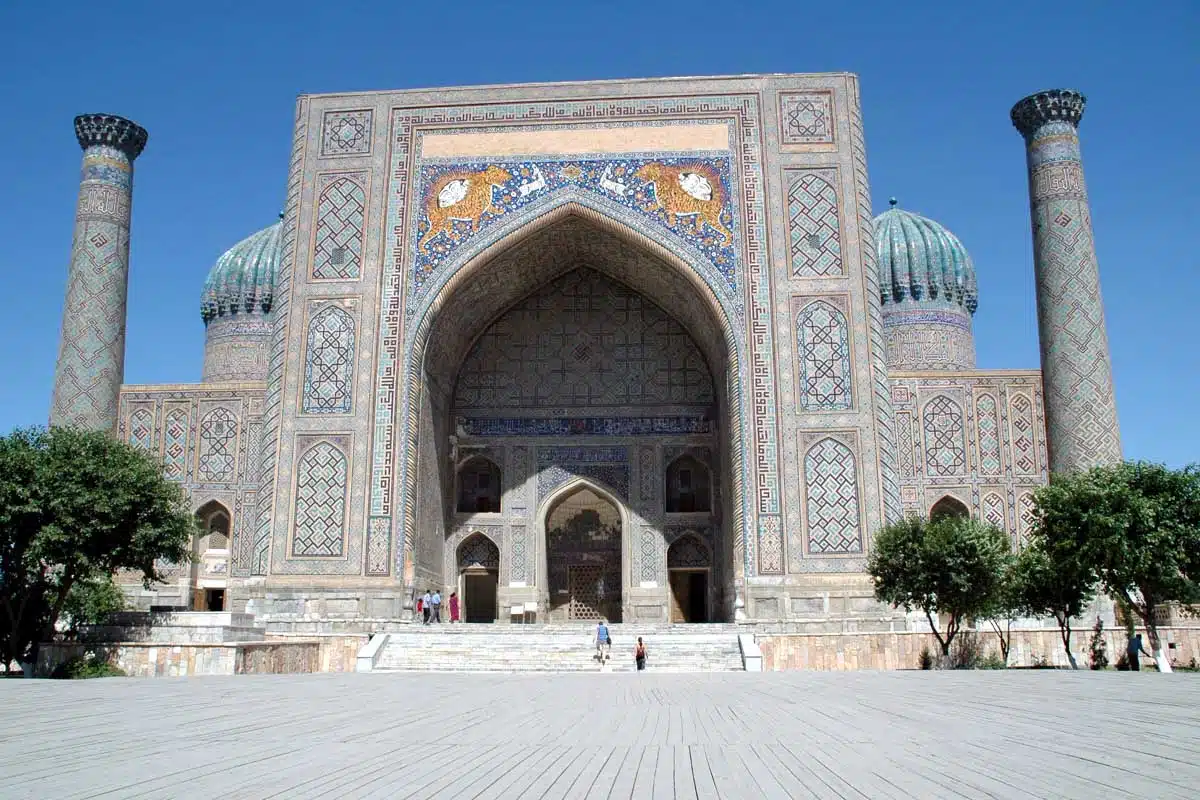
The Registan was the main square of medieval Samarkand, and three madrasas frame it. The Ulugh Beg Madrasa, from the 1410s, is the oldest. Opposite stands the Sher-Dor Madrasa, whose portal shows striped lions chasing deer under suns with human faces, a rare image in Islamic art. Between them, the Tilya-Kori Madrasa holds a mosque with a gilded interior. A ticket is needed to enter the courtyards. Come early for soft light and few people, then return after dark when the square is lit. See also things to do in Samarkand.
2. Shah-i-Zinda, Samarkand

Shah-i-Zinda, the “Tomb of the Living King”, is a narrow lane of mausoleums climbing a hill at the edge of old Samarkand. It grew around the shrine of Qusam ibn Abbas, a cousin of the Prophet Muhammad who is said to have brought Islam to the area in the 7th century. Most tombs date from the 14th and 15th centuries and carry some of the finest glazed and carved tilework in Central Asia. It is a pilgrimage site, so dress modestly and keep your voice low. Morning light shows the blue facades at their best.
3. Gur-e-Amir, Samarkand
Timur ordered this mausoleum in 1403 for his grandson and heir, Muhammad Sultan, and was soon buried here himself. His grandson Ulugh Beg, the astronomer ruler, also lies here. Outside, a ribbed turquoise dome rises on a tall drum. Inside, onyx panels, blue and gold decoration and a dark green jade tombstone mark Timur’s grave. A ticket is needed. Gur-e-Amir is a short walk from the Registan, and it is worth a second look in the evening when the building is lit.
4. Bibi-Khanym Mosque, Samarkand
Timur began this huge Friday mosque in 1399, after his campaign in India. It was built so quickly that parts started to fail early, and an earthquake in 1897 brought down much of what was left. Large sections have been rebuilt since Soviet times, but the height of the portal and domes still shows his ambition. In the courtyard stands a giant marble Quran stand. Visit in the morning and combine it with Siyob Bazaar next door.
5. Ak-Saray and Dorus Saodat, Shakhrisabz

Shakhrisabz is Timur’s home town, and he built his summer palace here, Ak-Saray, the “White Palace”. Only the two stumps of its giant entrance arch survive, still dressed in blue, white and gold tiles. Nearby, the Dorus Saodat complex holds the mausoleum of Timur’s eldest son Jahongir and a crypt prepared for Timur himself, who was never buried in it. UNESCO keeps the historic centre on its List of World Heritage in Danger. Most visitors come on a day trip by road from Samarkand, over a mountain pass.
6. Kalyan Minaret and Po-i-Kalyan, Bukhara
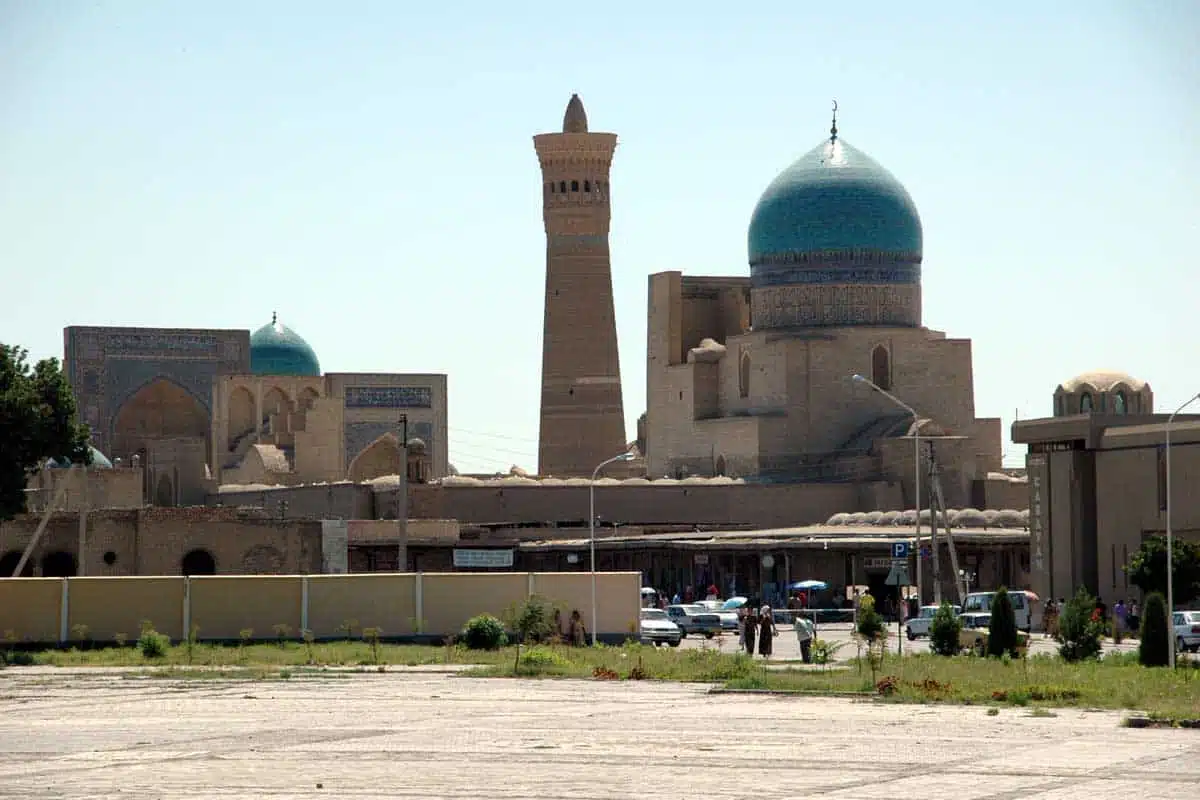
The Kalyan Minaret has risen about 45 metres over Bukhara since 1127, its brick laid in bands of different patterns. It stands on Po-i-Kalyan square, between the Kalyan Mosque, with its vast arcaded courtyard, and the 16th century Mir-i-Arab Madrasa with its two turquoise domes. Mir-i-Arab is still a working religious school, so visitors usually see only the entrance hall. Come at sunset, when the brick turns gold. See also things to do in Bukhara.
7. Samanid Mausoleum, Bukhara

This small cube of baked brick in Samani Park is the oldest Muslim monument in Bukhara, built at the turn of the 9th and 10th centuries as a family tomb for the Samanid rulers. There are no tiles: the whole surface, inside and out, is brick laid in woven patterns, over walls almost 2 metres thick. Its square plan with four arches follows the design of older fire temples. The patterns change as the shadows move, so try to see it in both morning and late afternoon light. It is an easy walk west of the old centre.
8. Chor Minor, Bukhara
Chor Minor means “four minarets”, and this little building has four towers, each topped with a turquoise dome. Khalif Niyaz-kul, a wealthy merchant, built it in 1807 as the gatehouse of a madrasa that has since disappeared. It stands in a quiet residential lane northeast of Lyab-i Hauz, and many visitors miss it. You can see it well from the street, so it fits easily into a walk. Go early or late in the day for the best light and fewer groups.
9. Itchan Kala, Khiva

Khiva’s walled inner town, Itchan Kala, packs madrasas, mosques and minarets into a small area inside mud brick walls, and it became a UNESCO World Heritage Site in 1990. Near the West Gate stands Kalta Minor, a wide, unfinished minaret wrapped in blue and green tiles. Islam Khodja Minaret, the tallest in Khiva, can be climbed for a view over the domes. Buy the combined ticket at the West Gate (Ota Darvoza), but note that the minaret climb and a few other sights cost extra. See also things to do in Khiva.
10. Pakhlavan Mahmud Mausoleum, Khiva
This is Khiva’s most loved shrine. Pakhlavan Mahmud lived in the 13th and early 14th centuries and is remembered as a poet, an unbeaten wrestler and a healer. He became the city’s patron saint, and the complex that grew around his tomb later became the burial place of Khiva’s khans. The main chamber is covered with some of the finest tilework in the city. Pilgrims come all day, so dress modestly. Entry is not included in the main Itchan Kala ticket and needs a separate one.
Tips for visiting
Spring and autumn are the best seasons, as summers are very hot and winters can be cold. The train is the easiest way between the cities: high-speed Afrosiyob trains link Tashkent, Samarkand and Bukhara, and trains also run on to Khiva. Book seats ahead with Uzbek Railways, because popular trains sell out. Many sites need a ticket, and opening times change by season, so check locally. At shrines and working mosques, cover shoulders and knees, and women may want a scarf. Many nationalities can enter Uzbekistan without a visa for short stays, but rules differ, so check your government’s current travel advice before you go.
Questions about Uzbekistan’s Silk Road architecture
How many days do I need to see Samarkand, Bukhara and Khiva?
About seven or eight days is enough for the main sights, including train travel. With less time, focus on Samarkand and Bukhara.
Can you go inside the madrasas?
Yes, most madrasas let visitors into their courtyards with a ticket, and many former student rooms now hold craft shops. A few, like Mir-i-Arab in Bukhara, are still working schools and are mostly closed to visitors.
What is the best time of day to photograph the monuments?
Early morning and the hour before sunset give warm light and fewer crowds. Several sites, including the Registan, are lit up after dark.


