Things to Do in Bukhara: 12 Best Sights and Experiences
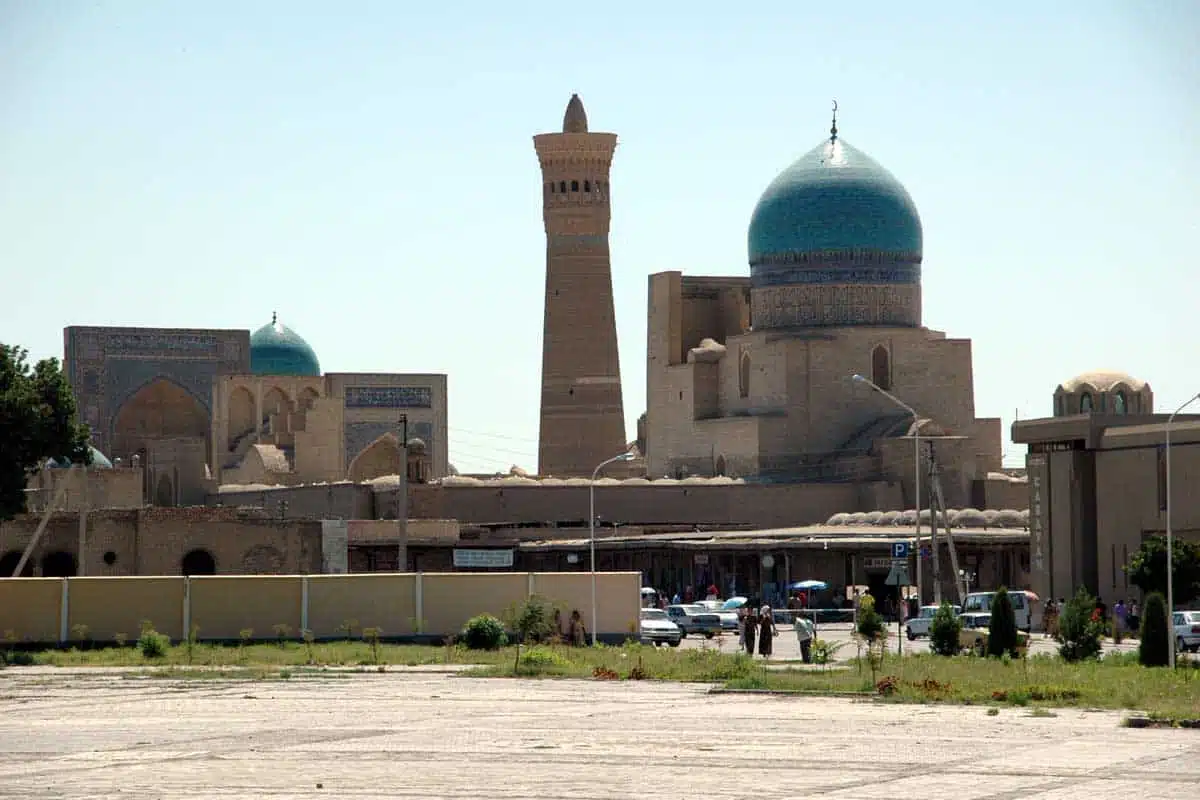
Bukhara is an old trading city on the Silk Road in the desert of south-central Uzbekistan. It is more than 2,000 years old, and its historic centre is a UNESCO World Heritage Site. Within a small area you will find minarets, madrasas, covered bazaars and old pools, and much of the medieval street plan has survived. You can get a feel for its brick and tile buildings in our free photos of Uzbekistan.
Bukhara feels calmer and more lived-in than Samarkand, and most of the main sights are an easy walk apart in the old town. It works well as part of a Silk Road trip that also includes Samarkand and Khiva. Here are the 12 best things to do in Bukhara, with tips on when to go and how to plan your trip.
1. Kalyan Minaret and the Po-i-Kalyan ensemble
The Po-i-Kalyan square is the heart of Bukhara. The Kalyan Minaret was built in 1127 and stands about 46 metres tall. According to local legend, Genghis Khan was so impressed by it that he spared it when he destroyed much of the city. Look closely at the bands of patterned brickwork, which change all the way up the tower. Next to it, the Kalyan Mosque dates from the early 16th century. Its large arcaded courtyard can hold thousands of worshippers.
2. Mir-i-Arab Madrasa
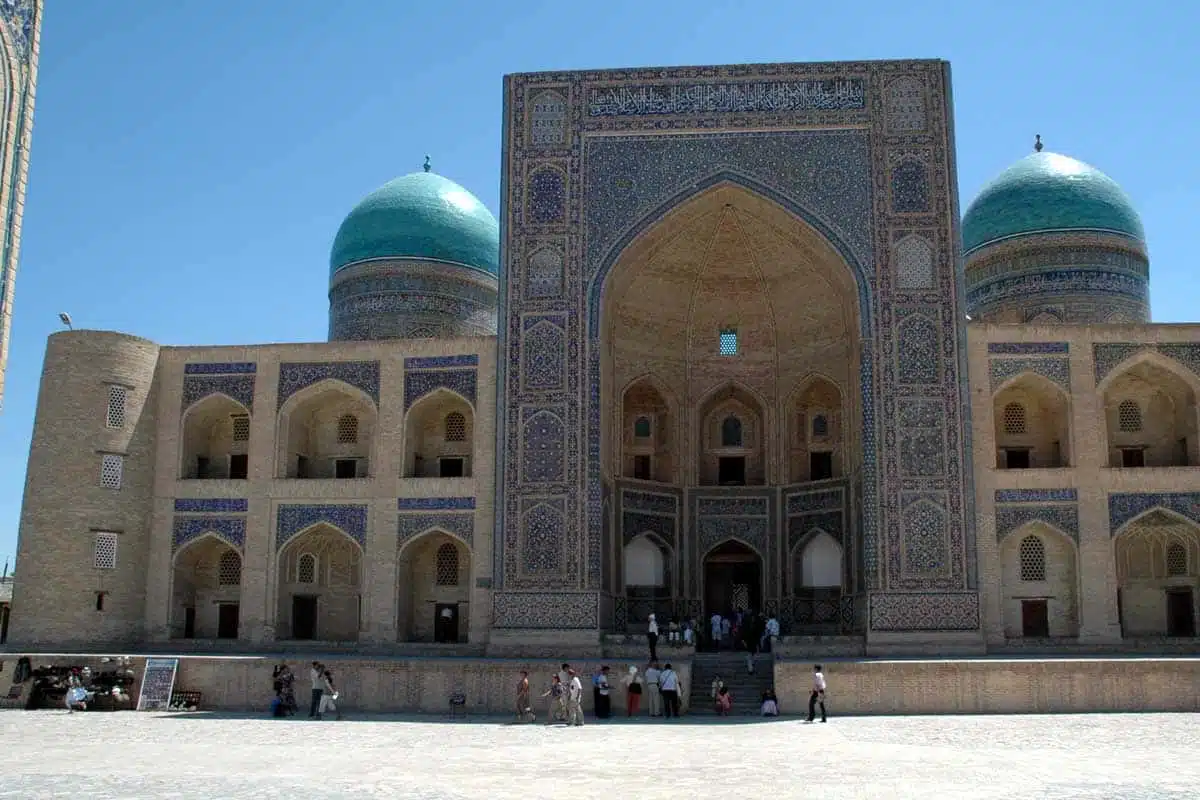
The Mir-i-Arab Madrasa faces the Kalyan Mosque across the square, and its two turquoise domes appear on many postcards of Bukhara. It was built in the 1530s and is still a working religious school. Visitors can usually only see the entrance area and look into the courtyard, so be respectful and dress modestly. If you enjoy its tiled portal, browse our free Islamic architecture pictures for more domes and portals.
3. The Ark fortress
The Ark is a huge walled citadel at the western edge of the old town, and people have lived on this mound for well over a thousand years. It was the home of the emirs of Bukhara until 1920. Inside, you walk up a covered ramp to courtyards, a throne room, a mosque and several small museums about the city’s history. In 1842 two British officers, Stoddart and Conolly, were executed on the square in front of it. You need a ticket to go in.
4. Bolo Hauz Mosque
The Bolo Hauz Mosque stands across the road from the Ark. It was built in 1712 and was the emir’s Friday mosque. Its best feature is the deep wooden porch, held up by tall, slender carved columns with painted ceilings above. In front of the porch is a pool that reflects the columns, which looks especially good in the late afternoon. The site is small, so it is easy to combine with your visit to the Ark.
5. The trading domes

Several 16th-century domed bazaars stand at old crossroads between Lyabi-Hauz and Po-i-Kalyan. Each one once had its own trade. Toki Zargaron was for jewellers, Toki Telpak Furushon for hat sellers and Toki Sarrafon for moneychangers. The covered hall of Tim Abdullah Khan is nearby. Today the domes sell carpets, suzani embroidery, ceramics, knives and the stork-shaped scissors Bukhara is known for. The domes are cool in the heat of the day, and haggling is normal.
6. Lyabi-Hauz
Lyabi-Hauz is a 17th-century square built around a pool and shaded by old mulberry trees. It is the social centre of the old town. Three historic buildings surround it: the Kukeldash Madrasa, and the Nadir Divan-Begi Madrasa and khanaka. The portal of the Nadir Divan-Begi Madrasa shows mythical birds and a sun with a human face. Look out for the statue of Khodja Nasreddin, the folk hero, on his donkey. In the evening, the teahouses and restaurants around the pool get busy.
7. Magoki Attori Mosque
The Magoki Attori Mosque sits below the level of the modern street, a few minutes from Lyabi-Hauz. It is one of the oldest mosques in Central Asia, and its carved brick facade dates from the 12th century. For centuries it was half buried by sand and rubble until it was dug out in the 1930s. Inside there is a small carpet museum. Archaeologists have found older temples beneath it, a sign of how many layers of history lie under Bukhara.
8. Ulugbek and Abdulaziz Khan madrasas
These two madrasas face each other near Toki Zargaron, about 200 years apart in age. The Ulugbek Madrasa was built in 1417 by Ulugbek, the astronomer ruler and grandson of Timur. Its decoration is simple. The Abdulaziz Khan Madrasa dates from 1652 and is much more ornate, with colourful tiles and painted details. It has been undergoing restoration, so parts of it may be closed or covered when you visit. Some of the old student cells now hold craft shops.
9. Samanid Mausoleum and Chashma-Ayub

The Samanid Mausoleum stands in a park west of the Ark. It dates from the early 10th century and is one of the oldest surviving monuments of Islamic architecture in Central Asia. It is a small cube made entirely of baked brick, laid in patterns that change as the light moves. A short walk away is Chashma-Ayub, with an unusual cone-shaped dome. Legend says the prophet Job made a spring appear here. The building now holds a small museum about water.
10. Chor Minor
Chor Minor, meaning “four minarets”, stands in a residential lane north-east of Lyabi-Hauz. It was built in 1807 as the gatehouse of a madrasa that has since disappeared. Each of its four towers has a turquoise dome and slightly different decoration. One of the towers collapsed in 1995 and was later rebuilt. It takes about 15 minutes to walk there from Lyabi-Hauz, and on the way you pass ordinary houses and quiet streets that most tour groups never see.
11. Sitorai Mohi Khosa palace
Sitorai Mohi Khosa was the summer palace of Alim Khan, the last emir of Bukhara. It lies a few kilometres north of the city and was built in the early 20th century. The architecture mixes Russian and European styles with local craftwork. The White Hall is decorated with carved plaster and mirror glass. The rooms now house displays of applied arts, and peacocks walk around the gardens. Take a taxi and allow a couple of hours.
12. Bahauddin Naqshband complex
This large complex lies about 12 km east of the city. It surrounds the tomb of Bahauddin Naqshband, the 14th-century founder of the Naqshbandi Sufi order. It is one of the most important pilgrimage sites in Uzbekistan, with courtyards, mosques, a pool and an old tree that pilgrims touch for luck. It is an active religious site, so dress modestly and keep your voice low. Many visitors combine it with Sitorai Mohi Khosa on a half-day taxi trip.
When to visit Bukhara
The best months are April, May, September and October, when days are warm and evenings are pleasant for walking. Summer in Bukhara is very hot and dry, often around 40°C, so if you go then, sightsee early in the morning and late in the afternoon. Winters are cold and quiet, with fewer visitors and some seasonal shows or cafés closed. Golden hour is the best time to photograph the minarets and domes.
Tips for planning your trip
Most visitors arrive by train from Tashkent or Samarkand. Fast Afrosiyob services and slower trains run on this line, and tickets can sell out in busy months, so book ahead. Bukhara’s railway station is in Kagan, outside the city, so you will need a taxi to reach the old town. The city also has an airport with domestic and some international flights. The old town is compact and best explored on foot, and taxis are cheap for trips further out. Two full days covers the main sights, and three days gives you time for the palace, Bahauddin and some slow afternoons. Several monuments need tickets, which you buy at each site. Wear modest clothing at mosques and madrasas. Entry rules for Uzbekistan can change, so check your government’s current travel advice before you go.
Questions about Bukhara
How many days do you need in Bukhara?
Two days is enough for the main sights in the old town. With three days you can add Sitorai Mohi Khosa and the Bahauddin Naqshband complex at an easy pace.
How do I get from Samarkand to Bukhara?
Trains, including fast Afrosiyob services, link the two cities, and that is the easiest way to travel. Book ahead in spring and autumn, when seats go quickly.
Can you go inside the mosques and madrasas?
Most monuments are open to visitors, and many need a ticket. Working religious sites such as the Mir-i-Arab Madrasa only allow limited access, and you should dress modestly everywhere.


