Grand Bazaar and Spice Bazaar in Istanbul: 10 Things to See and Buy

The Grand Bazaar (Kapalıçarşı) and the Spice Bazaar (Mısır Çarşısı) are the two great historic markets of Istanbul’s old city, on the European side between Beyazıt and the Golden Horn. One is a covered maze of jewellers, carpet dealers and lamp sellers that grew around a 15th-century hall. The other is a 17th-century food market full of spices, teas and Turkish delight. You can see both in our free photos of Turkey.
The two bazaars are a short walk apart, so they fit easily into one half day. Here are the 10 best things to do in the Grand Bazaar and Spice Bazaar, with tips on when to go and how to plan your trip.
1. Enter the Grand Bazaar through a historic gate
The Grand Bazaar has more than 20 gates. The busiest are the Beyazıt gate on the west side and the Nuruosmaniye gate on the east, next to the Nuruosmaniye Mosque. Look up as you pass through. The gates at either end of the main street were rebuilt after the 1894 earthquake and carry the tuğra, or monogram, of Sultan Abdülhamid II. Note the name of the gate you used. The inner streets look alike, and gates make the best meeting points.
2. Walk Kalpakçılar Caddesi and the main streets

The bazaar has around 61 covered streets and more than 4,000 shops under painted vaults. Kalpakçılar Caddesi, the main street between the Beyazıt and Nuruosmaniye sides, is lined with jewellers and gold shops. On the side streets, shops of the same trade sit together: carpets and kilims, leather, ceramics, copper, lamps and textiles. Expect friendly calls from shopkeepers. A simple “no, thank you” is enough if you only want to look.
3. See the Cevahir Bedesten, the oldest hall
The heart of the bazaar is the Cevahir Bedesten, also called the İç Bedesten. It was completed in 1461 on the orders of Sultan Mehmed II. This domed stone hall held the most valuable goods, and its income supported Hagia Sophia. Today it is the place for antiques, old silver, coins, jewellery and copperware. It feels calmer than the outer streets, and its thick walls and small domes show the bazaar’s original form.
4. Visit the Sandal Bedesteni
The second domed hall, the Sandal Bedesteni, was built some years after the first. Much of the textile trade moved there, while the older hall kept the luxury goods. In the 20th century it served for many years as an auction hall. Today it holds textile and souvenir shops under rows of small domes on stone pillars.
5. Look into the old hans around the bazaar
Around the Grand Bazaar are hans, old trading inns built around courtyards where merchants stayed, stored goods and worked. Zincirli Han, on the north side of the bazaar, has a small, quiet courtyard. Büyük Valide Han, a large 17th-century han a few minutes away, still holds workshops and small traders. Its rooftop views are well known online, but roof access is often restricted. Treat the courtyards as the visit and do not climb anywhere without permission.
6. Walk downhill through Mahmutpaşa to Eminönü
From the bazaar’s north side, the streets drop steeply towards the Golden Horn through the Mahmutpaşa area. This is where Istanbul families shop for household goods, clothes, toys and wedding items, and it feels much less touristy than the covered bazaar. The walk to the Spice Bazaar takes around 15 to 20 minutes. It gets very crowded, so keep bags closed and in front of you.
7. See the Spice Bazaar building and the New Mosque

The Spice Bazaar stands on the Eminönü waterfront beside the New Mosque (Yeni Cami). It was completed in 1664 for Hatice Turhan Sultan as part of the mosque complex, and the shop rents paid for the mosque’s upkeep. Its Turkish name, Mısır Çarşısı, means Egyptian Bazaar. The name comes from the revenue from Ottoman Egypt that helped fund it. The vaulted hall is L-shaped, with six gates and roughly 85 to 90 shops.
8. Shop for spices and teas
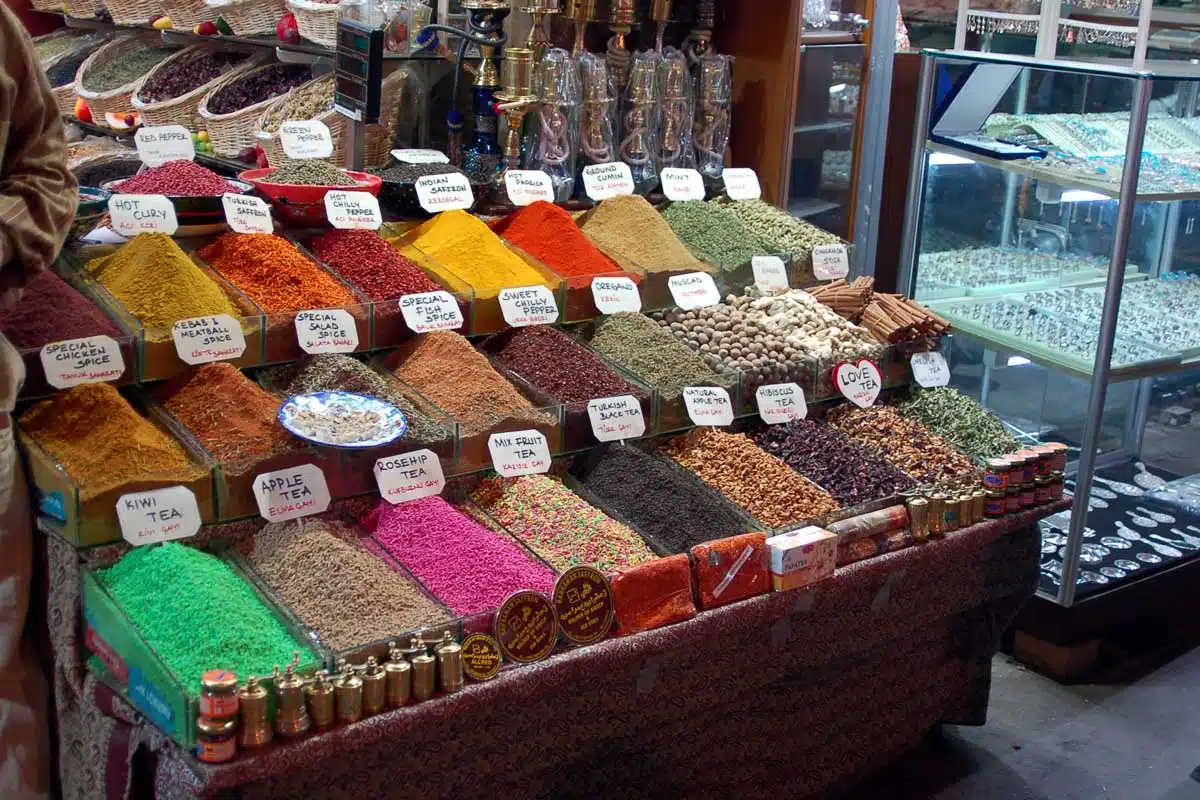
Spices are still the main reason to come. Shops pile up sumac, pul biber (red pepper flakes), isot pepper, cumin, dried mint and ready blends for köfte and grilled meat. Teas include apple, linden, sage and many herbal mixes. Most traders let you smell before you buy and can vacuum-pack spices for travel. Be careful with very cheap “saffron”, which is often safflower. Check your home country’s rules on bringing food back.
9. Taste Turkish delight, nuts and dried fruit

Turkish delight, or lokum, comes in rose, lemon, pomegranate, pistachio and many other flavours. It is often cut to order and boxed. You will also find pistachios, hazelnuts, dried apricots and figs, baklava, pestil (dried fruit sheets) and cezerye, a carrot sweet. Ask for a taste before choosing. Just outside, in Eminönü, Hacı Bekir has made lokum since the 18th century and is a good place to compare.
10. Explore the streets around the Spice Bazaar
The lanes outside the Spice Bazaar are as lively as the hall. On Tahmis Sokağı, Kurukahveci Mehmet Efendi grinds Turkish coffee, and there is usually a queue at the counter. Nearby stalls sell cheese, olives, cured meats, seeds and plants. Above one gate, Pandeli serves Turkish dishes in rooms lined with turquoise tiles. A few minutes west, Sinan’s Rüstem Paşa Mosque is known for its İznik tiles. Dress modestly and avoid prayer times.
When to visit the Grand Bazaar and Spice Bazaar
Both bazaars are covered, so they work in any season, rain or heat. Weekday mornings are the calmest. By late morning, tour groups arrive and the Spice Bazaar in particular gets packed. The Grand Bazaar is closed on Sundays and on religious holidays. The Spice Bazaar opens on Sundays but closes on the main days of Ramazan Bayramı and Kurban Bayramı, whose dates move each year. Opening times change, so check before you go.
Tips for planning your trip
The T1 tram stops at Beyazıt-Kapalıçarşı for the Grand Bazaar and at Eminönü for the Spice Bazaar. Ferries from Kadıköy and Üsküdar on the Asian side also arrive at Eminönü. Start at the Grand Bazaar in the morning, walk down to the Spice Bazaar and finish with a ferry or a walk across the Galata Bridge. Allow two to three hours for the Grand Bazaar and about an hour for the Spice Bazaar. Haggling is normal for carpets, jewellery and souvenirs, but less so for food sold by weight. Carry some cash and watch your bags in crowds. Check your government’s current travel advice before you travel. For the rest of the city, see our Istanbul travel guide, and for a base close to the old city, read where to stay in Istanbul.
Questions about the Grand Bazaar and Spice Bazaar
Is the Grand Bazaar open on Sundays?
No. The Grand Bazaar is closed on Sundays and religious holidays, but the Spice Bazaar opens on Sundays, so visit the Grand Bazaar from Monday to Saturday.
Do you need tickets for the Grand Bazaar or Spice Bazaar?
No. Both bazaars are free to enter and you do not need to book, though guided tours are available if you want more background.
How far is the Spice Bazaar from the Grand Bazaar?
It is about 15 to 20 minutes on foot, downhill through Mahmutpaşa. You can also take the T1 tram from Beyazıt-Kapalıçarşı to Eminönü.


