Things to Do in Graz: 12 Best Sights and Experiences
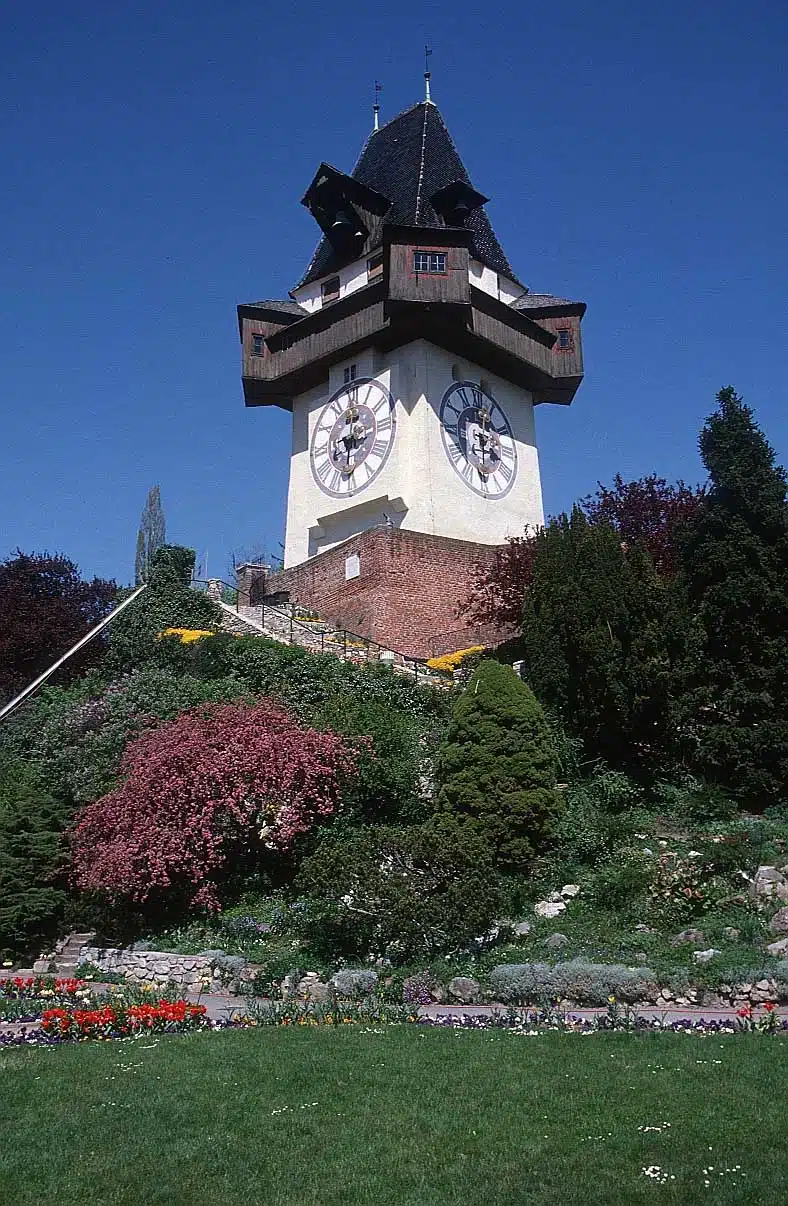
Graz is Austria’s second-largest city and the capital of Styria, set on both banks of the river Mur in the south-east of the country. Its old town of red roofs, Renaissance courtyards and a clock tower on a wooded hill is a UNESCO World Heritage Site, together with Schloss Eggenberg. Bold modern architecture by the river adds contrast.
Graz is compact, easy to walk and calmer than Vienna or Salzburg, with a big student population, good cafés and excellent food. Browse our free photos of Graz to get a feel for the city. Here are the 12 best things to do in Graz, with tips on when to go and how to plan your trip.
1. Visit the Clock Tower on the Schlossberg
The Uhrturm, or Clock Tower, is the symbol of Graz. It stands on the Schlossberg, a rocky hill above the old town that once carried a large fortress. When Napoleon’s troops pulled the fortress down in 1809, the people of Graz paid to save the Clock Tower and the bell tower. Look closely at the clock: the long hand shows the hours and the short hand the minutes.
2. Choose your way up: steps, lift or funicular
The stone steps start at Schlossbergplatz and zigzag up the rock face, with the view improving at every turn. To save your legs, take the Schlossberg lift inside the rock or the Schlossbergbahn funicular. For the way down, try The Slide, a 170-metre underground slide that winds around the lift shaft. You need a ticket, and riders must be at least 1.30 metres tall.
3. Walk the Schlossberg park and see the Kasematten
At the top, shady paths lead past fortress ruins, the bell tower and viewpoints over the sea of red roofs below. The Kasematten, the old fortress cellars, are now an open-air stage for concerts and theatre in summer. A café terrace near the Clock Tower is a good place to sit and look across the city to the hills beyond.
4. Start on the Hauptplatz

The Hauptplatz is the main square of Graz and the natural place to begin a walk. The large town hall, rebuilt in the late 19th century, fills one side. In the middle stands the Archduke Johann Fountain, whose four female figures represent the rivers of old Styria: the Mur, Enns, Drau and Sann.
5. Stroll along the Herrengasse
The Herrengasse leads south from the Hauptplatz and is the main street of the old town, lined with shops, cafés and grand buildings. Look out for the Painted House, whose whole front is covered in 18th-century frescoes of figures from mythology. Trams run along the street, but it is nicer on foot. Explore the side lanes and courtyards too.
6. Step into the Landhaus courtyard

A few steps from the Hauptplatz, the Landhaus is the seat of the Styrian parliament and one of the finest Renaissance buildings in Austria. The Italian architect Domenico dell’Allio designed it in the 16th century. Walk through the gateway into the courtyard, with rows of stone arcades on several floors. It hosts concerts in summer.
7. See the Styrian Armoury
Next door, the Landeszeughaus is the largest historic armoury in the world, with more than 32,000 objects. Suits of armour, helmets, swords, pikes and early guns stand in long rows, much as they did when Styria guarded the border against Ottoman raids. In April 2026 it received the European Heritage Label. From April to October you can explore on your own; in winter, entry is mostly by guided tour.
8. Find the Cathedral, Mausoleum and double spiral staircase
A short walk east of the Hauptplatz is the old Burg quarter. Graz Cathedral is a late Gothic church with a plain exterior and a rich Baroque interior. Right beside it stands the Mausoleum of Emperor Ferdinand II, one of the city’s key Baroque buildings. Inside the Burg, the double spiral staircase of 1499 has two stone stairways that twist around each other, part and meet again. It is free to see.
9. Visit the Kunsthaus Graz

Cross to the west bank of the Mur to see the Kunsthaus, a blue, bubble-shaped art museum known as the Friendly Alien. Peter Cook and Colin Fournier designed it for Graz’s year as European Capital of Culture in 2003. Nozzles on the roof let in daylight, and the river façade works as a large light screen. Inside are changing exhibitions of contemporary art.
10. Cross the Murinsel and walk by the river

Close to the Kunsthaus, the Murinsel is a steel shell floating in the river, linked to both banks by footbridges. The New York artist Vito Acconci designed it for 2003. Inside are a café and a small amphitheatre, and it is lit up after dark. From here, follow the riverside paths for a quieter view of the city, with the Schlossberg rising above the trees.
11. Tour Schloss Eggenberg
On the western edge of Graz, Schloss Eggenberg is the city’s grandest palace. Its design is built around time and the universe, with 365 windows and 24 state rooms, the finest being the Planetary Room. The state rooms open from spring to the end of October and close in winter to protect them. The landscape park, where peacocks roam, is pleasant in any season. Tram line 1 goes there from the centre.
12. Shop at a farmers’ market and try Styrian food
Graz calls itself the Capital of Delight, and a farmers’ market shows why. Stalls on Kaiser-Josef-Platz and Lendplatz sell local fruit, vegetables, cheese and bread in the mornings. Look for Styrian pumpkin seed oil, a dark green oil used on salads and even ice cream. In the evening, try Backhendl, crisp fried chicken, with a glass of wine from southern Styria.
When to visit Graz
Late spring to early autumn is the best time. From May to September café terraces are busy, the Schlossberg is green and the Kasematten has its summer programme. The Eggenberg state rooms and the Armoury’s self-guided visits also run in the warmer months. Autumn brings the grape and pumpkin harvest, and in December Christmas markets fill the old town squares.
Tips for planning your trip
Graz has its own airport, and there are direct trains from Vienna. Since December 2025 the new Koralm Railway links Graz with Klagenfurt in well under an hour. The old town is easy to walk, and the Altstadtbim lets you ride trams free of charge between the Hauptplatz and Jakominiplatz. The Graz Card covers public transport and the Schlossberg lift. Allow two days, or three with Schloss Eggenberg. The Kunsthaus and the Armoury close on Mondays. From Vienna, you could add a few days in the Wachau Valley; heading south, Varaždin in Croatia makes a good next stop. Check your government’s current travel advice before you go.
Questions about Graz
How many days do you need in Graz?
Two days covers the Schlossberg, the old town, the Kunsthaus and the Murinsel. Add a third day for Schloss Eggenberg.
Is it free to go up the Schlossberg?
Yes, the park is free and you can walk up the steps at no cost. The lift, the funicular and The Slide need a ticket.
Can you visit Graz as a day trip from Vienna?
Yes, direct trains make it possible, but the day will be rushed. Staying overnight lets you see the old town in the evening, when the Clock Tower and the Murinsel are lit up.


