Graz in Pictures: 52 Free Photos and a Short City Guide
Graz in 52 free photos: the Clock Tower on the Schlossberg above the red roofs, the Hauptplatz with the town hall and the Archduke Johann fountain, the painted house fronts of the Herrengasse, the arcaded Landhaus courtyard and the Armoury, the blue bubble of the Kunsthaus and the steel Murinsel on the Mur, Gothic churches, and the streets and green trams of the old town. Each set of photos has a short note on the place.
Graz at a glance
- Getting there: about two and a half hours by train from Vienna; Graz also has its own airport south of the city.
- Getting around: the old town is compact and walkable; trams leave from the Hauptplatz and Jakominiplatz.
- Money: euro.
- When to go: May to October; Graz is one of the sunniest cities in Austria. The Christmas markets fill the squares in December.
How to download: click a photo to see it large, then use Download. The originals are about 1200 × 800 pixels: right for blog posts, slides, social media, school projects and video call backgrounds.
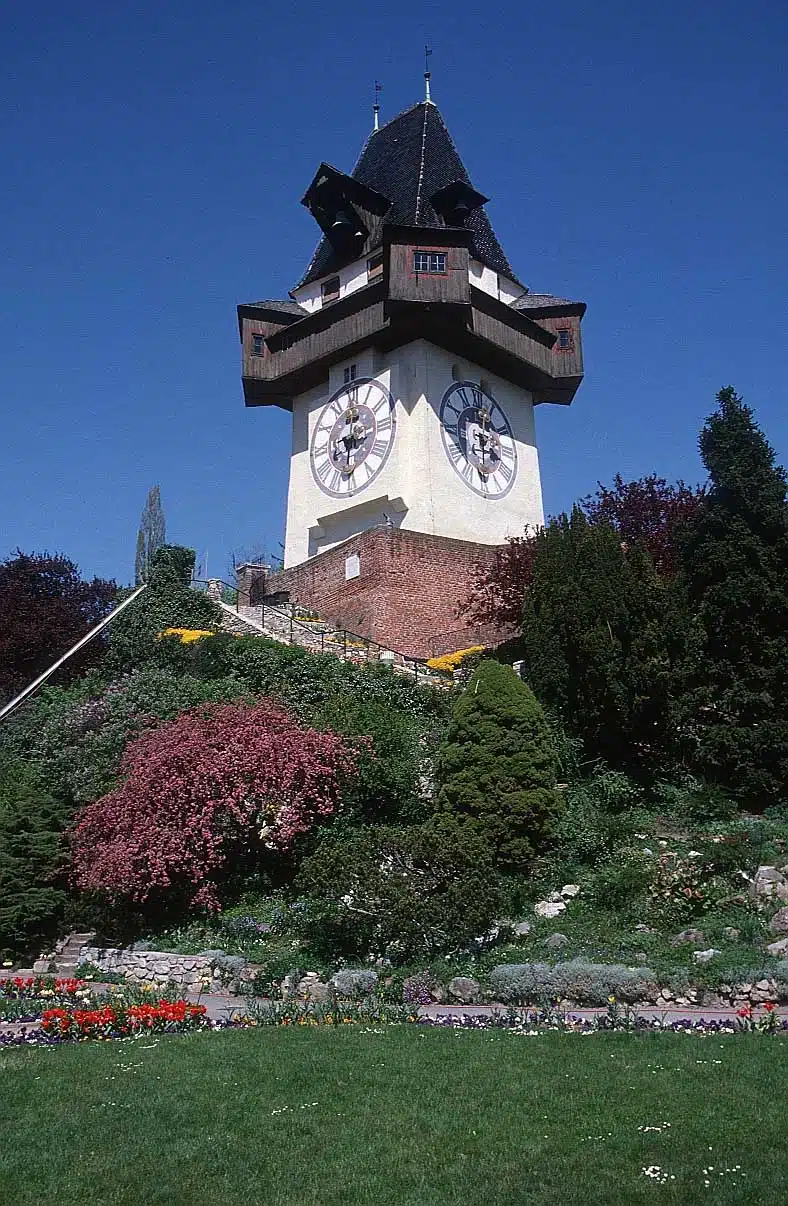
The Schlossberg and the Clock Tower
The Clock Tower, the Uhrturm, has stood on the Schlossberg since the 16th century; on its face the hands are swapped, so the long hand shows the hours. Take the funicular, the glass lift inside the rock or the steps cut into the cliff to the top, where the Kasematten, the old cellars of the fortress, are now an open-air stage.


The Hauptplatz and the town hall
The main square, with the neo-Renaissance town hall and the fountain of Archduke Johann of 1878, is where the trams meet and the sausage stands open early. From here the old town of Graz, on the UNESCO World Heritage list with Schloss Eggenberg, spreads in every direction.


Herrengasse, the Landhaus and the Armoury
The Herrengasse is the main street of the old town, lined with palaces and the Painted House covered in frescoes. The Landhaus, the seat of the Styrian parliament, has one of the finest Renaissance arcaded courtyards north of the Alps, and next door the Armoury holds some 32,000 weapons and suits of armour, the largest historic armoury in the world.


The Kunsthaus and the Murinsel
When Graz was European Capital of Culture in 2003, it built the Kunsthaus, a museum of modern art that looks like a blue bubble landed on the river bank, known as the “Friendly Alien”, and the Murinsel, a floating island of steel and glass in the Mur, with a café and an open-air stage.


Churches and towers
Gothic and Baroque churches with tall towers stand between the houses of the old town.


Streets, squares and trams
Lanes and courtyards, house fronts in pastel colours, cafés, the green trams and the railway station.


Tips for a first visit
- Walk up the Schlossberg in the morning and take the lift down; the view is best before noon.
- Book the Armoury in advance in summer; it opens from spring to autumn.
- Take tram 1 to Schloss Eggenberg for its palace, park and peacocks.
- Try pumpkin seed oil on salad and ice cream; it is the taste of Styria.
More about Graz
Graz, Austria’s second city, in the south east of the country, has the distinction of being the only city in the world with two UNESCO titles: ‘World Heritage Site’ for its architecture and mountain-ringed position on the River Mur, and ‘City of Design’ reflecting its cultural life. Graz was European Capital of Culture in 2003 and City of Culinary delights in 2008.
Starting life as a Roman frontier fort, this spa town became the home of the ruling Habsburgs. The remains of their fortress, Schlossberg Castle (open daily 24 hours, free admission) are set in a landscaped public park on top of the berg. Visitors wanting a great view of the Italian Renaissance style roofs and alleyways of the old town from the clock tower high above have three choices: walk up the winding steps of the Schlossberg, take the glass elevator, or ride the traditional funicular (there is a charge for the latter two).
Graz has so many museums that there is something for everyone. An interest in history is catered for at the Garisonmuseum (open May to October except Mondays), with its huge collection of uniforms and weapons; or if you prefer, try the Toy Museum for toys throughout the ages (open all year except Sundays). Other museums cover Natural History, Archaeology, Hunting, Agriculture, Coins, Folk Life and Media.
Graz’s gothic Cathedral (Domkirche), one of Austria’s finest buildings, is a great favourite with the many visitors to the city. The other chief architectural sights are the Opera House, the Town Hall and the Landhaus, a former administrative building. All these date from the 16th or 17th centuries, but there are powerful modern buildings too: don’t miss the amazing Kunsthaus Graz, known as ‘the Friendly Alien’ and designed by Peter Cook and Colin Fournier. It opened in 2003 as an exhibition centre for contemporary art from the 1960s to the present day (open Tuesday to Sunday 10.00 – 17.00).
If sculpture is your thing, the Austrian Sculpture Park four miles out of the city exhibits around sixty works by Austrian sculptors in seven hectares of gardens (open April to October except Saturdays, 10.00 to 20.00).
Graz is a cultured city where you should never be bored, and its resident population of around 250,000 is supplemented by 50,000 students at its six universities, giving it a youthful and lively atmosphere. With its perfect mix of old and new, Graz could be the ideal place for a long weekend.
More free photos
- Vienna pictures
- Salzburg pictures
- Prague pictures
- Munich pictures
- Free church pictures
- Free night city pictures
- Free bus and tram pictures
- Free city street pictures and city backgrounds
- Danube pictures
- Austria pictures
- Europe pictures
Questions about these Graz photos
Can I use these Graz pictures for free?
Yes, for personal and commercial projects. All we ask is a link back to BigFoto.com; the box at the top of the page has a credit link you can copy.
Why are the hands of the Graz Clock Tower swapped?
The clock first had only the long hand for the hours, so it could be read from far away; the minute hand was added later, and made shorter.