Champs-Élysées and Arc de Triomphe: A Visitor Guide to the Avenue and the Arch

The Champs-Élysées is the wide avenue lined with trees that runs for about 1.9 km across western Paris, from Place de la Concorde up to the Arc de Triomphe. It is a parade route, a shopping street and the place where France marks its big national days. At the top, the Arc de Triomphe covers the Tomb of the Unknown Soldier and a flame that has burned since 1923.
You can see both in half a day, but the avenue feels very different in the morning and at night. Before you go, have a look at our free photos of Paris to get a feel for the avenue and the arch. Here are the 10 best things to do on the Champs-Élysées and at the Arc de Triomphe, with tips on when to go and how to plan your trip.
1. Walk the Champs-Élysées from Concorde to the arch
The best way to get to know the avenue is to walk all of it. Start at Place de la Concorde and walk gently uphill towards the Arc de Triomphe, which gets bigger with every block. The walk is about 1.9 km and takes around half an hour without stops. The lower half has gardens and chestnut trees. The upper half is all shops, cinemas and cafés. The royal gardener André Le Nôtre first laid out the line in the 17th century, and the arch stays in view the whole way.
2. Place de la Concorde and the Champs-Élysées gardens
Place de la Concorde is the largest square in Paris and the starting point of the avenue. In the middle stands the Luxor Obelisk, more than 3,000 years old, which Egypt gave to France in the 19th century. There is a large fountain on each side of it. Between the square and the Rond-Point, the Jardins des Champs-Élysées have shady paths and two theatres, the Théâtre Marigny and the Théâtre du Rond-Point. This end is calmer than the upper avenue and a good place to rest.
3. Grand Palais and Petit Palais
Just off the lower avenue, two palaces of glass and stone face each other across Avenue Winston-Churchill. Both were built for the 1900 World’s Fair. The Grand Palais fully reopened in 2025 after a long renovation, and it holds major exhibitions under its huge glass roof. Check what is on and book ahead for big shows. The Petit Palais is home to the City of Paris fine arts museum. Entry to its permanent collection is free, and there is a quiet garden café in the courtyard.
4. Shops, cafés and Avenue Montaigne
The upper Champs-Élysées is mostly big brand flagship stores, and many stay open later than shops elsewhere in Paris. Look out for the Guerlain building at number 68 and the Ladurée tea room at number 75, which is known for its macarons. For high fashion, turn into Avenue Montaigne. Together with Avenue George-V it forms the “Golden Triangle”, where the big Paris fashion houses have their boutiques. Cafés on the avenue itself are expensive. The side streets are usually better value.
5. Look closely at the Arc de Triomphe
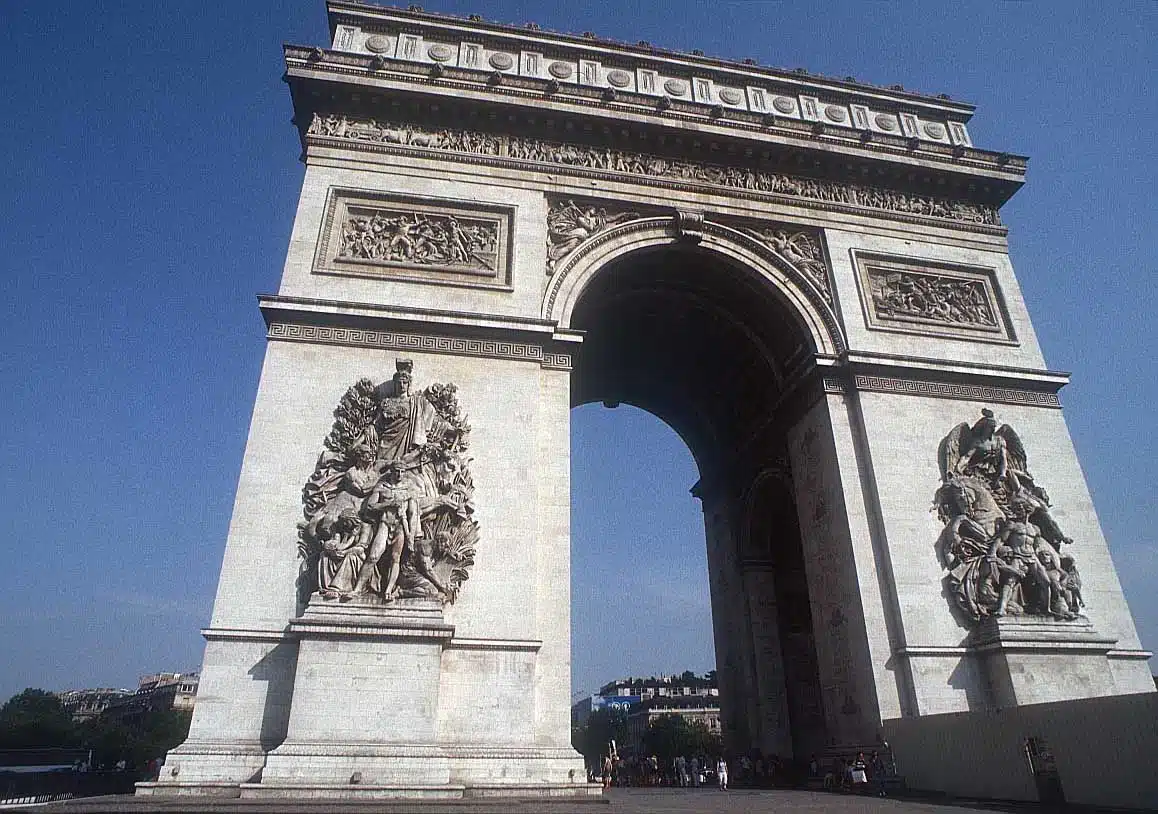
Napoleon ordered the arch in 1806 after his victory at Austerlitz, but it was not finished until 1836, long after his fall. It stands about 50 metres high in the middle of Place Charles de Gaulle, where 12 avenues meet. That is why many people still call the square l’Étoile, “the star”. Walk round the base to see the four large groups of sculpture. The best known is François Rude’s Departure of the Volunteers of 1792, often called La Marseillaise. The names of battles and generals are carved inside the arches.
6. Climb to the rooftop terrace
A ticket lets you go inside the arch, where a small museum room explains its history. From there you climb 284 steps to the roof. The view runs straight down the Champs-Élysées towards Concorde and the Louvre, and the other way to the towers of La Défense. You also see the Eiffel Tower and the 12 avenues spreading out below you. Book a time slot online in the busy months. Under-18s and EU residents aged 18 to 25 get in free with ID. Visitors with reduced mobility should check access on the official website first.
7. The Tomb of the Unknown Soldier

Under the arch lies an unknown French soldier from the First World War. Eight unidentified bodies were brought to Verdun, where a young soldier chose one coffin. It reached the arch on 11 November 1920 and was buried there in January 1921. Britain buried its Unknown Warrior in Westminster Abbey on the same day in 1920, and these two were the first tombs of their kind. The tomb is at ground level and you do not need a ticket to see it. Please keep your voice down.
8. Watch the rekindling of the eternal flame

The flame at the head of the tomb was first lit on 11 November 1923 and has never gone out. Every evening at 6.30pm, members of veterans’ associations rekindle it in a short, silent ceremony with flags and wreaths. Visiting groups and schoolchildren often take part. It is free, and anyone can watch from behind the barriers. Arrive 15 to 20 minutes early for a good spot, dress respectfully and keep your phone on silent. On 8 May and 11 November the ceremonies are much larger.
9. See the avenue lit up at night

The Champs-Élysées changes after dark. Car headlights stream up towards the floodlit arch, and the shop fronts stay bright late into the evening. For the classic view, use the pedestrian islands in the middle of the road at the main crossings, and stay well clear of the traffic. The arch is open in the evening, so you can also watch the city lights come on from the roof. Combine this with the flame ceremony for a full evening.
10. Time your trip for a big event
Many of France’s big public moments happen on this avenue. On the first Sunday of each month it is closed to cars, so you can walk down the middle of the road. On 14 July the national military parade usually comes down the avenue, and the Tour de France has traditionally finished here in July. From November into January, Christmas lights hang in the trees. On New Year’s Eve, huge crowds gather for a show on the Arc de Triomphe. On these days, expect security checks and roads to be closed.
When to visit the Champs-Élysées and Arc de Triomphe
Spring and early autumn are best for walking, with mild weather and long evenings. Summer is the busiest time at the arch, so book a time slot and go early in the day. Winter has its own good points. The Christmas lights are up, and because the sun sets early you can see the sunset from the roof and then go down for the 6.30pm flame ceremony. Weekday mornings are the quietest time on the avenue. Sundays are livelier, especially when the road is closed to cars.
Tips for planning your trip
Metro line 1 runs right under the avenue, with stops at Concorde, Champs-Élysées Clemenceau, Franklin D. Roosevelt, George V and Charles de Gaulle Étoile. Lines 2 and 6 and the RER A also stop at Charles de Gaulle Étoile. Never try to cross the roundabout to reach the arch. Instead, use the underground passage from the top of the Champs-Élysées or from Avenue de la Grande Armée. The Paris Museum Pass covers entry to the arch. Allow half a day: one hour for the arch, one for the walk, and more if you visit the museums. Opening times change with the season, so check before you go. Keep an eye on your bags in crowds, because pickpockets work this area. The avenue is also a common place for demonstrations, so check your government’s current travel advice before you travel.
Questions about the Champs-Élysées and Arc de Triomphe
Do you need a ticket to see the Tomb of the Unknown Soldier?
No. You can reach the tomb and the eternal flame through the underground passage without a ticket. You only need a ticket to go inside the arch and climb to the roof.
How do you get to the Arc de Triomphe safely?
Take the underground passage from the top of the Champs-Élysées or from Avenue de la Grande Armée, close to Charles de Gaulle Étoile station. Crossing the roundabout at street level is dangerous and not allowed.
How long does it take to walk the Champs-Élysées?
The avenue is about 1.9 km long, so the walk takes around 30 minutes without stops. With time for shops, gardens and photos, most people take one to two hours.


