Knossos Visitor Guide: The Minoan Palace near Heraklion, Crete

Knossos is the largest Minoan palace on Crete, on the southern edge of Heraklion, the island’s capital. The palace was built and rebuilt here between about 2000 and 1350 BC. It is the setting of the myths of King Minos, the Labyrinth and the Minotaur. In 2025 it joined the UNESCO World Heritage List as part of the Minoan Palatial Centres, together with sites such as Phaistos, Malia and Zakros.
Sir Arthur Evans dug most of the palace from 1900 and rebuilt parts of it in concrete, which is why you see red columns, roofs and painted walls today. The original frescoes are in the museum in Heraklion, so plan to see both. Get a feel for the site first with our free photos of Knossos and Crete. Here are the 10 best things to do at Knossos, with tips on when to go and how to plan your trip.
1. Start at the West Court
Most visits begin at the West Court, a wide paved space that was the formal approach to the palace. Look for the three large round pits, called kouloures, which may have stored grain or held rubbish. Behind them rises the West Façade, built of big cut gypsum blocks. From here you can see how the palace sits on its low hill.
2. South Propylaeum and the Procession Fresco
On the south side, Evans rebuilt the South Propylaeum, a grand gateway with tall columns. Its walls carry a copy of part of the Procession Fresco, with young men carrying vessels as gifts, including the well known Cup-Bearer. A long corridor once led visitors past rows of these painted figures towards the heart of the palace. Nearby you also pass a copy of the Prince of the Lilies, a painted relief of a young man wearing a crown of flowers.
3. The Central Court
The Central Court is the long, open rectangle at the centre of the palace. The four main wings were arranged around it, with the royal quarters, workshops, shrines, store rooms and halls opening off its sides. It was probably used for gatherings and ceremonies. Stand in the middle to see the Throne Room complex to the west and the east wing dropping down the slope.
4. The Throne Room

The Throne Room, off the west side of the Central Court, is the best known room at Knossos and is often called the oldest throne room in Europe. A stone throne stands against the wall, with stone benches on both sides and painted griffins lying among plants. Opposite is a sunken lustral basin, probably used for rituals. Visitors queue through the anteroom and look in from a barrier, so expect a short wait at busy times.
5. The store rooms and giant storage jars

The palace was also a huge storehouse. Along the west wing runs a row of long, narrow store rooms, the West Magazines, where large clay jars called pithoi held oil, wine and grain. Some still stand in place, taller than a child, with rope patterns moulded on the clay. Other giant pithoi stand elsewhere in the palace and give a clear idea of how much wealth passed through Knossos.
6. The North Entrance and the bull fresco
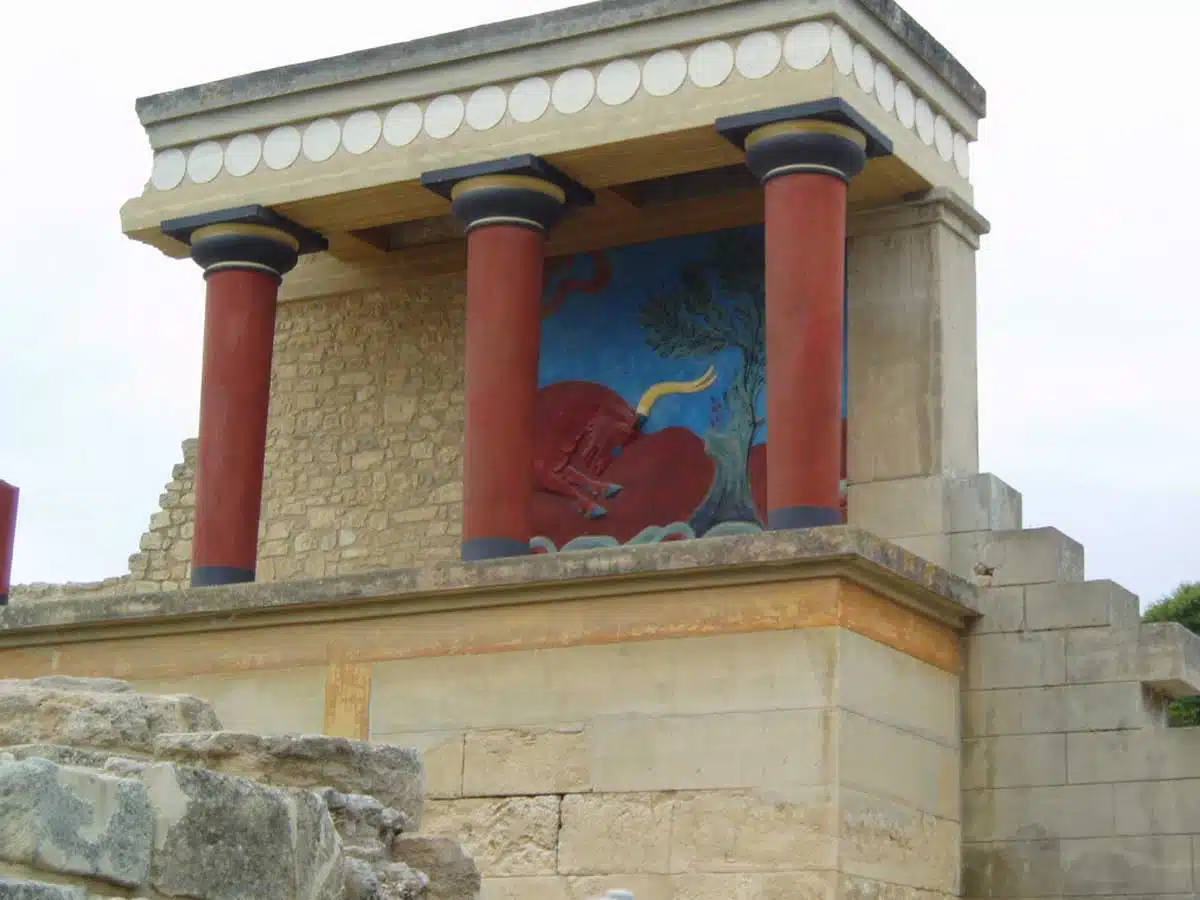
The North Entrance is a narrow passage that climbs towards the Central Court. Evans rebuilt the portico above it, with red columns and a copy of a charging bull in painted relief on the back wall. It is one of the most photographed corners of the site. Bulls were central to Minoan art and religion, and this image links neatly to the later Greek myth of the Minotaur.
7. The Theatral Area and the Royal Road
Just north-west of the palace is the Theatral Area, a paved space with wide stone steps on two sides where people may have stood or sat to watch ceremonies. From here the Royal Road heads west. It is a paved Minoan street, often described as one of the oldest roads in Europe. It once led towards the Little Palace and the town that spread around the palace.
8. The Grand Staircase and the royal apartments

The east wing was built into the slope, so it went down several floors. The Grand Staircase leads down beside a light well, an open shaft that brought daylight and air into the rooms below. Further in are the Hall of the Double Axes and the so-called Queen’s Megaron, with a copy of the dolphin fresco. Some parts are closed for protection at times, so you may see them from the walkways rather than walk through.
9. Look closely at Evans’s reconstructions
Part of the fun at Knossos is working out what is Minoan and what is modern. Evans used reinforced concrete to rebuild floors, roofs and columns. He painted the columns red and black, and they are wider at the top than at the bottom. His work helps you imagine a building of several floors, but scholars still argue about how accurate it is. Compare the restored rooms with the bare foundations around them and see which you find more convincing.
10. See the original frescoes in Heraklion Archaeological Museum
The finds from Knossos are in the Heraklion Archaeological Museum in the city centre. Here you can see the real Bull-Leaping Fresco, La Parisienne, the Prince of the Lilies and pieces from the Throne Room, along with pottery, seals and jewellery. The museum needs its own ticket and has its own opening times, so allow at least two hours for it.
When to visit Knossos
Knossos is open all year, but opening times change by season, with longer days in summer and shorter ones from November to March. Spring and autumn, especially April to June and September to October, are the most comfortable months, with mild weather and green hills. July and August are very hot and there is little shade on the site. Coach tours and cruise passengers arrive from mid-morning, so come at opening time or in the late afternoon for fewer crowds and softer light for photos.
Tips for planning your trip
Heraklion has Crete’s main airport and a ferry port with links to Piraeus. From the city centre, local buses (line 2) and taxis reach Knossos in a short ride, and there is parking near the entrance. Entry now uses timed tickets. You can buy them online through the official Hellenic Heritage e-ticket system or at the gate, though queues can be long in summer. Large luggage and food are not allowed. Allow two to three hours, and bring water, a hat and good shoes. Paths and facilities are being improved in stages until about 2030, so some routes may change. Check your government’s current travel advice before you go. For more ideas, see our essential places to visit in Greece, the historical landmarks of Athens and our beginner’s guide to Mediterranean islands.
Questions about Knossos
How long do you need at Knossos?
Most visitors spend two to three hours on the site. Add another two hours or so if you also visit the Heraklion Archaeological Museum on the same day.
Do I need to book Knossos tickets in advance?
Entry is by timed ticket, and booking online through the official Hellenic Heritage e-ticket system means you avoid the queue in busy months. Tickets are also sold at the entrance.
Are the frescoes at Knossos original?
No, the frescoes you see on site are copies. The surviving originals are kept in the Heraklion Archaeological Museum.


