Brandenburg Gate and Reichstag: A Visitor Guide to Berlin’s Government Quarter
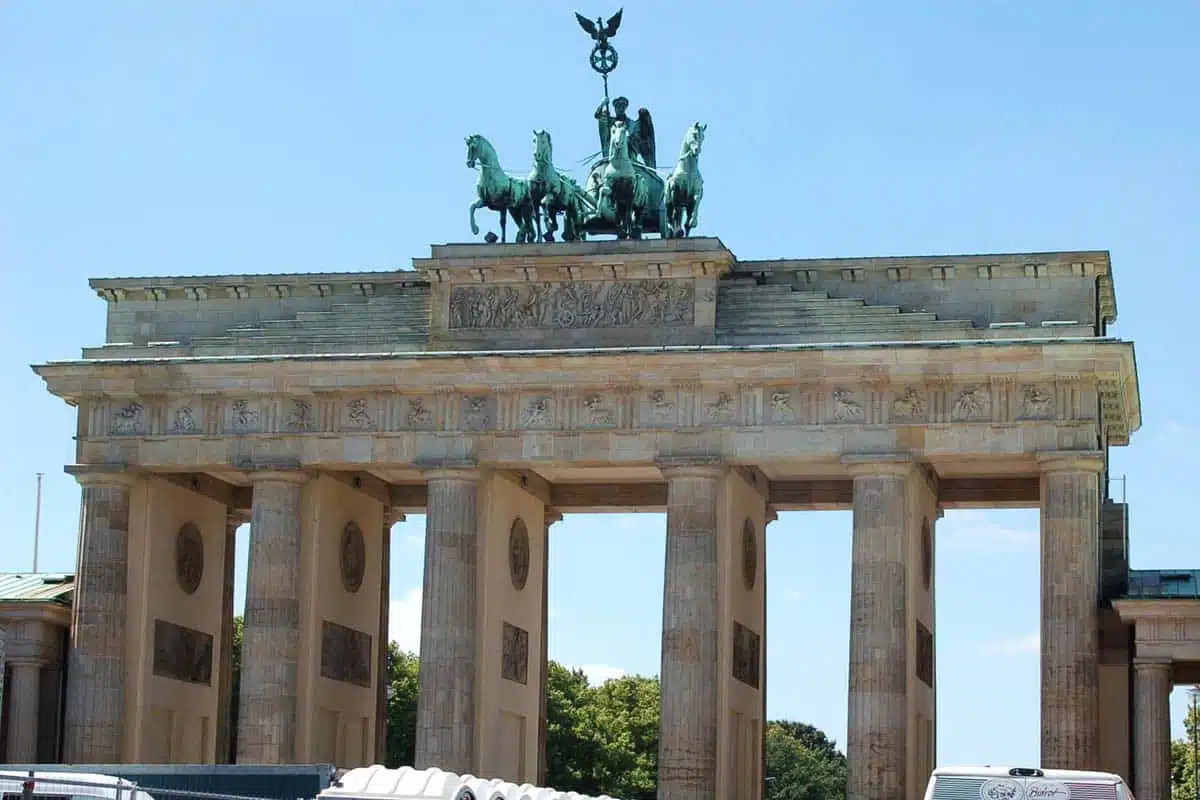
The Brandenburg Gate and the Reichstag stand a few minutes’ walk apart in the centre of Berlin, on the eastern edge of the Tiergarten park and close to the River Spree. With the government quarter and the Holocaust Memorial nearby, they tell Germany’s story from the Prussian kings to today’s parliament, and most of it is free.
The Reichstag dome needs advance registration and the memorials deserve time. Before you go, browse our free photos of Berlin to get a feel for the place. Here are the 10 best things to do around the Brandenburg Gate and the Reichstag, with tips on when to go and how to plan your trip.
1. Walk through the Brandenburg Gate
Built between 1788 and 1791 to a design by Carl Gotthard Langhans, the gate is Berlin’s best-known landmark. On top stands the Quadriga by Johann Gottfried Schadow, a goddess driving a four-horse chariot. Napoleon took it to Paris in 1806 and it came back in 1814. From 1961 to 1989 the gate stood in the border zone, cut off by the Wall. It has been closed to cars since 2002, so you can walk through at any hour.
2. Pariser Platz and the Room of Silence
Pariser Platz, the square on the east side of the gate, is lined with the Hotel Adlon, the Academy of Arts and the French and US embassies, and leads on to the Unter den Linden boulevard. In the northern gatehouse of the gate is the Raum der Stille, or Room of Silence. It opened in 1994 as a plain, non-denominational room where anyone can sit quietly for a few minutes.
3. See the Reichstag building

The Reichstag was finished in 1894 for the parliament of the German Empire, and the words “Dem deutschen Volke” (To the German people) were added above the entrance in 1916. It burned in 1933, was badly damaged in 1945 and stood beside the Wall during the Cold War. After reunification Norman Foster rebuilt it, and the Bundestag has met here since 1999. The lawn in front, Platz der Republik, is best for photos.
4. Climb the glass dome and roof terrace

The glass dome is free, but you must register in advance with the Bundestag visitor service, online, by fax or by post, giving each visitor’s name and date of birth. A few same-day places may be available at the visitor service outpost near the building. Bring photo ID and expect an airport-style security check. Inside, a spiral ramp circles a mirrored cone that lights the chamber below. The dome closes for cleaning on some weeks each year, but the roof terrace stays open.
5. Attend a lecture or a debate
To see how parliament works, book a lecture in the visitors’ gallery of the plenary chamber. These talks last about 45 minutes, cover the work of parliament and the history of the building, and only take place when parliament is not sitting. On sitting days you can instead watch a debate from the public gallery, though there is no interpretation into other languages. Places are limited, so book in writing well ahead. A visit to the dome usually follows the lecture.
6. Walk the government quarter along the Spree

North of the Reichstag, a line of modern buildings called the Band des Bundes (Ribbon of the Federal Government) crosses a bend of the Spree. The Paul-Löbe-Haus holds committee rooms and offices for members of parliament, and a two-level footbridge links it across the river to the Marie-Elisabeth-Lüders-Haus, home of the parliamentary library. Follow the riverbank past the White Crosses, a memorial to people killed trying to cross the Wall.
7. See the Federal Chancellery
At the western end of the ribbon stands the Federal Chancellery, the office of the German chancellor, completed in 2001. Berliners nicknamed its large white cube with a round opening the “washing machine”. You cannot go inside on a normal day, but there are good views from the riverbank and the Tiergarten side. Once a year the federal government holds an open day, usually in summer, when the Chancellery and the ministries welcome the public.
8. Walk through the Holocaust Memorial

A short walk south of the gate, the Memorial to the Murdered Jews of Europe covers almost 19,000 square metres with 2,711 grey concrete stelae of different heights. It was designed by the New York architect Peter Eisenman and opened in 2005. The ground dips and rises, so the narrow lanes feel very different in the centre than at the edge. The field is open at all times and is free. Please do not climb or jump on the slabs.
9. Visit the Information Centre under the memorial
Beneath the field of stelae, the Information Centre (Ort der Information) explains the persecution and murder of Europe’s Jews through the stories of individual people and families. Its quiet rooms give names and faces to the abstract field above. The entrance is on the eastern side, on Cora-Berliner-Straße. It is closed on Mondays, there is a security check, and queues can form at busy times, so allow at least an hour.
10. Find the memorials in the Tiergarten
Between the Reichstag and the gate is the Memorial to the Sinti and Roma of Europe Murdered under National Socialism, which opened in 2012. It is a dark pool with a stone at its centre, and a fresh flower is placed on the stone every day. Opposite the Holocaust Memorial, a concrete block remembers the homosexual men and women persecuted by the Nazis. A short walk west along Straße des 17. Juni brings you to the Soviet War Memorial.
When to visit the Brandenburg Gate and Reichstag
The area is open all year. Late spring and early autumn bring mild weather and fewer crowds than July and August, when dome slots go quickly. Come early for quiet photos of the gate, or after dark when it is lit up. An evening visit to the dome gives you views over the city lights. Winter is cold, and around New Year’s Eve the area near the gate is fenced off for a large street party.
Tips for planning your trip
The S-Bahn and U-Bahn station Brandenburger Tor is next to the gate, the U5 stops at Bundestag right by the Reichstag, and Berlin Hauptbahnhof is a short walk across the Spree. Everything is close together, so walk. Allow half a day for the gate, the dome and the Holocaust Memorial, or a full day if you add the Information Centre, a Spree boat trip and the Tiergarten. Register for the dome early, carry ID and travel light for the security checks. Watch for pickpockets in the crowds, and check your government’s current travel advice before you travel. Travelling on? See our Dresden pictures or our guide to things to do in Düsseldorf.
Questions about the Brandenburg Gate and Reichstag
Is the Reichstag dome free to visit?
Yes, entry to the dome and roof terrace is free. You must register in advance with the Bundestag visitor service and bring photo ID on the day.
Can you go inside the Brandenburg Gate?
You cannot climb the gate, but you can walk through it at any time. The small Room of Silence in the northern gatehouse is open to visitors.
How long do you need at the Holocaust Memorial?
Walking through the field of stelae takes 20 to 30 minutes. Add at least an hour if you visit the Information Centre underneath.


