Best Ancient Ruins in the Middle East: 10 Sites to Visit
This guide covers the best ancient ruins in the Middle East, from Nabataean tombs in Jordan to Persian palaces in Iran and Greek theatres in Turkey. Many empires left their mark here, and many sites are still remarkably complete. You can walk on Roman paving stones, climb Herod’s desert fortress and stand in front of carvings made 2,500 years ago.
Our photographers have visited most of the places below, and you can browse our free ancient ruins pictures for more. Conditions in parts of the region change quickly, so plan with care. Here are 10 of the best ancient ruins in the Middle East, with tips on visiting them.
1. Petra, Jordan
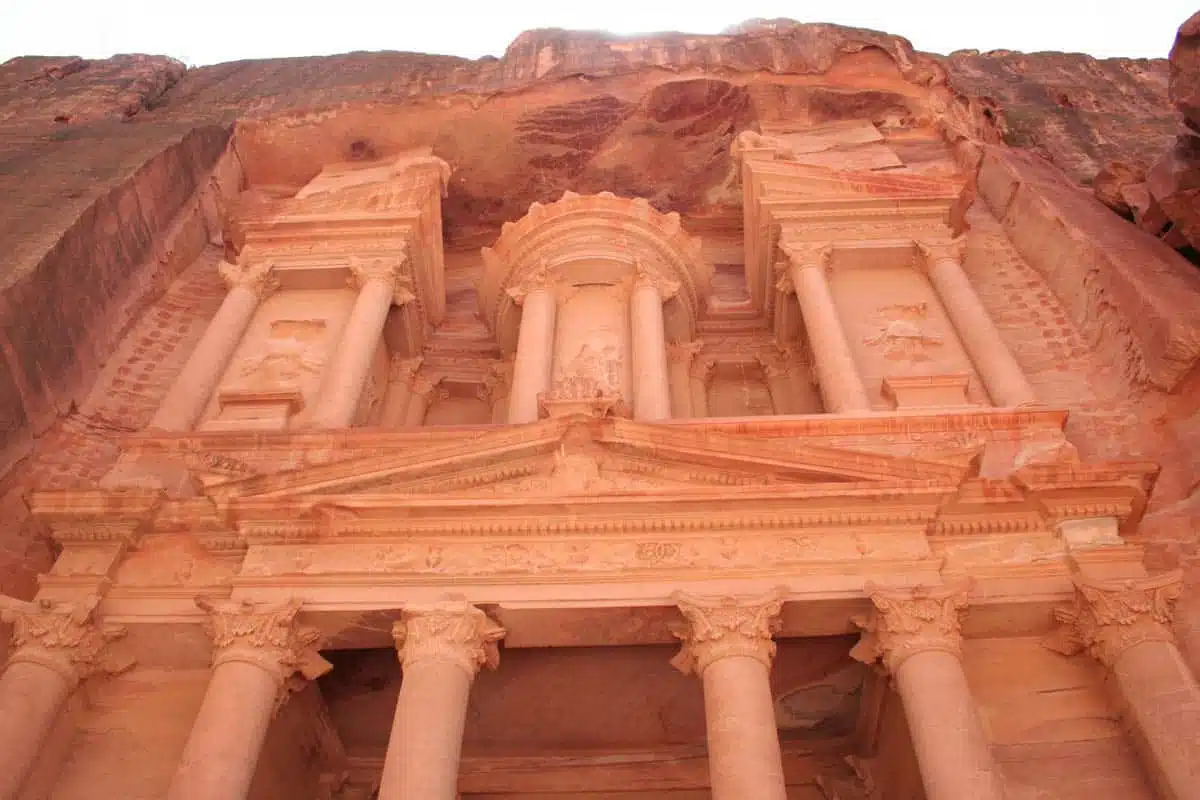
Petra was the capital of the Nabataeans, a trading people who carved tombs, temples and houses into rose-coloured sandstone cliffs. You enter through the Siq, a narrow gorge about 1.2 km long that opens suddenly onto the Treasury (Al-Khazneh). Beyond it lie the Royal Tombs, the old city centre and, up roughly 800 rock-cut steps, the Monastery. Allow at least one full day. Buy the Jordan Pass before you arrive, as it covers entry. Petra by Night needs a separate ticket. See also our five best pictures of Petra.
2. Jerash, Jordan

Jerash, ancient Gerasa, is one of the best-preserved Roman cities in the Middle East. You walk in through Hadrian’s Arch, then reach the Oval Plaza, a wide square ringed by columns, and the long Cardo, still paved with its original stones. The South Theatre, the Temple of Zeus and the Temple of Artemis are all within walking distance. Jerash is less than an hour’s drive north of Amman, so it makes an easy day trip. The Jordan Pass also covers entry here.
3. Masada, Israel

Masada is a fortress on a flat-topped rock high above the Dead Sea. Herod the Great built palaces, storerooms and huge water cisterns here. Later, Jewish rebels held out against a Roman siege that ended in about 73 CE, and the Roman camps and siege ramp are still visible below. Masada is a UNESCO World Heritage Site. A cable car runs up from the eastern visitor centre. Fit walkers can climb the Snake Path at dawn, but it closes early on hot days.
4. Caesarea, Israel

Herod also built Caesarea Maritima, a port city on the Mediterranean coast roughly halfway between Tel Aviv and Haifa. Caesarea National Park protects a restored Roman theatre, Herod’s palace on a rocky headland, the remains of his artificial harbour and a long hippodrome where chariot races and games were held. Just north of the park, a Roman aqueduct with rows of arches runs along a sandy beach. Visit the ruins in the afternoon, then walk to the aqueduct for the evening light.
5. Kidron Valley Tombs, Jerusalem
Below the Old City walls, between the Temple Mount and the Mount of Olives, the Kidron Valley holds a group of tombs from the Second Temple period. The Tomb of Absalom (Yad Avshalom) and the Tomb of Zechariah are monuments cut free from the bedrock, with carved columns and pointed roofs. Next to them, the Bnei Hezir tomb is cut straight into the cliff. You can walk down from the Lions’ Gate or from the Mount of Olives. The paths are steep, so avoid the midday heat.
6. Persepolis, Iran

Persepolis, known in Persian as Takht-e Jamshid, was the ceremonial capital of the Achaemenid kings. Darius the Great began it around 515 BC on a vast stone terrace, and Alexander the Great burned it in 330 BC. Climb the staircase to the Gate of All Nations, then study the Apadana stairway, carved with delegations bringing tribute and a lion attacking a bull. The site lies about an hour’s drive from Shiraz and is a UNESCO World Heritage Site. Many governments currently advise against travel to Iran, so check your government’s latest advice first.
7. Pergamon, Turkey

Pergamon, above the modern town of Bergama north of İzmir, was the capital of a powerful Hellenistic kingdom and later a major Roman city. Its acropolis holds the Temple of Trajan, the terrace of the Great Altar and a theatre cut into a hillside so steep that it is often called the steepest of the ancient world. A cable car runs up from the town. Leave time for the Asclepion, an ancient healing centre below the hill, and the Red Basilica in town. Pergamon is a UNESCO World Heritage Site.
8. Ephesus, Turkey
Ephesus, near Selçuk on Turkey’s Aegean coast, was one of the largest cities of the Roman east. Marble streets lead past the two-storey facade of the Library of Celsus and the Great Theatre. The Terrace Houses, where wealthy families lived among wall paintings and mosaics, need an extra ticket inside the site. Ephesus is a UNESCO World Heritage Site and very popular with cruise passengers from Kuşadası, so arrive at opening time or come late in the afternoon.
9. Baalbek, Lebanon
Baalbek in the Bekaa Valley was the Roman city of Heliopolis, home to some of the largest temples the Romans ever built. Six giant columns of the Temple of Jupiter still stand, and the Temple of Bacchus is one of the best-preserved Roman temples anywhere, with a richly carved doorway. Baalbek is a UNESCO World Heritage Site and a long day trip from Beirut. Security in Lebanon can change quickly, so check your government’s current travel advice before planning a visit.
10. Göbekli Tepe, Turkey
Göbekli Tepe, near Şanlıurfa in southeastern Turkey, is far older than anything else on this list. Around 11,000 years ago, hunter-gatherers raised rings of huge T-shaped stone pillars here and carved them with foxes, boars, snakes and birds. A large roof now protects the main enclosures, and walkways let you look down into them. It is a UNESCO World Heritage Site. Combine it with the Şanlıurfa Archaeology Museum, and avoid high summer, when the heat is intense.
Tips for visiting
Summer heat at desert sites can be dangerous, so start at opening time, carry plenty of water and wear a hat and shoes with good grip, as old paving is often worn smooth. Opening times change by season and during religious holidays, so check them shortly before you go. Combined tickets such as the Jordan Pass save time and money, and a licensed local guide helps at large sites. Security rules can change at short notice, so check your government’s current travel advice before you book.
Questions about ancient ruins in the Middle East
What is the best time of year to visit ancient ruins in the Middle East?
Spring (March to May) and autumn (September to November) bring mild temperatures and good light. Winter works too, but days are short and can be wet.
How many days do you need in Petra?
One full day covers the Siq, the Treasury, the Royal Tombs and the Monastery if you start early. Two or three days let you add longer trails and see the site at a slower pace.
Can you visit Petra and Masada on the same trip?
Yes, many travellers combine Jordan and Israel by crossing a land border. Crossing rules and opening times change, and crossings can close at short notice, so check the latest information before you plan your route.


