Things to Do in Vienna: 12 Best Sights and Experiences

Vienna, the capital of Austria, sits on the Danube in the east of the country. For centuries it was the seat of the Habsburg emperors, and their palaces, churches and museums still shape the city. Add music, Art Nouveau buildings and old coffee houses, and it suits both a short break and a longer stay.
The historic centre is compact and UNESCO-listed, so you can see a lot in a few days. Browse our free photos of Vienna. Here are the 12 best things to do in Vienna, with tips on when to go and how to plan your trip.
1. St Stephen’s Cathedral
Stephansdom stands at the centre of the old town, and its patterned tile roof is a symbol of Vienna. The back of the nave is free to enter, but other areas need a ticket. Climb the 343 steps of the South Tower for a view over the centre, or take the lift up the North Tower to see the Pummerin, the cathedral’s largest bell. Guided tours lead down into the catacombs.
2. The Graben, Kärntner Strasse and Mozarthaus
On Stephansplatz, the glass front of the modern Haas Haus reflects the cathedral. Walk along the Graben, a wide pedestrian street, to the Baroque plague column put up after the plague of 1679. Kärntner Strasse, the main shopping street, runs south to the Opera. Behind the cathedral, Mozarthaus Vienna on Domgasse is the only one of Mozart’s Vienna homes that survives. He wrote The Marriage of Figaro there.
3. The Hofburg

The Hofburg was the Habsburgs’ main residence and now holds museums, state rooms and the Austrian President’s offices. One ticket covers the Imperial Apartments, the Sisi Museum and the Silver Collection. Enter from Michaelerplatz under the big dome and walk through to the Heldenplatz. The complex also includes the Imperial Treasury, the State Hall of the National Library and the Spanish Riding School, where performances should be booked ahead.
4. The Ringstrasse
The Ringstrasse was laid out in the 19th century where the city walls once stood. Along it are the Parliament, reopened in 2023 after renovation and offering free guided tours, the neo-Gothic City Hall, the Burgtheater, and the art and natural history museums facing each other across Maria-Theresien-Platz. Trams 1 and 2 follow much of the Ring. On foot, find the Mozart Monument in the Burggarten and the golden Johann Strauss statue in the Stadtpark.
5. The Vienna State Opera
The State Opera on the Ring is one of the world’s leading opera houses, with performances on most evenings from September to June. Standing places are sold for most performances, the easiest way to see a show without booking months ahead; check the opera’s website for how they are sold. Guided tours of the foyers and auditorium run on many days, with times depending on rehearsals.
6. Schönbrunn Palace and gardens

The Habsburgs’ summer palace is a UNESCO World Heritage Site together with its gardens. Palace tours use timed tickets, but the main park is free. Walk uphill to the Gloriette for a view back over the palace and city; there is a café inside. The iron and glass Palm House and Tiergarten Schönbrunn, the world’s oldest zoo, are also in the grounds. Take the U4 to Schönbrunn or Hietzing.
7. The Belvedere and Klimt’s The Kiss
Prince Eugene of Savoy had the two Baroque Belvedere palaces built in the early 18th century, with formal gardens between them. The Upper Belvedere holds the world’s largest collection of Gustav Klimt’s paintings, including The Kiss, plus works by Egon Schiele and Oskar Kokoschka. The Lower Belvedere hosts temporary exhibitions. Each palace needs a ticket, while the gardens are free. Tram D stops close to the upper palace.
8. Karlsplatz: Karlskirche and Otto Wagner’s pavilions
Karlskirche, with its green dome and two columns modelled on Trajan’s Column in Rome, was built after the plague of 1713. The lift that once rose inside the dome was removed in 2022; a tour now leads to a viewing platform above the entrance. Across the square stand Otto Wagner’s two Art Nouveau pavilions; one opens seasonally as a small museum. The Wien Museum, reopened in 2023, tells the city’s story.
9. The Secession and the Naschmarkt
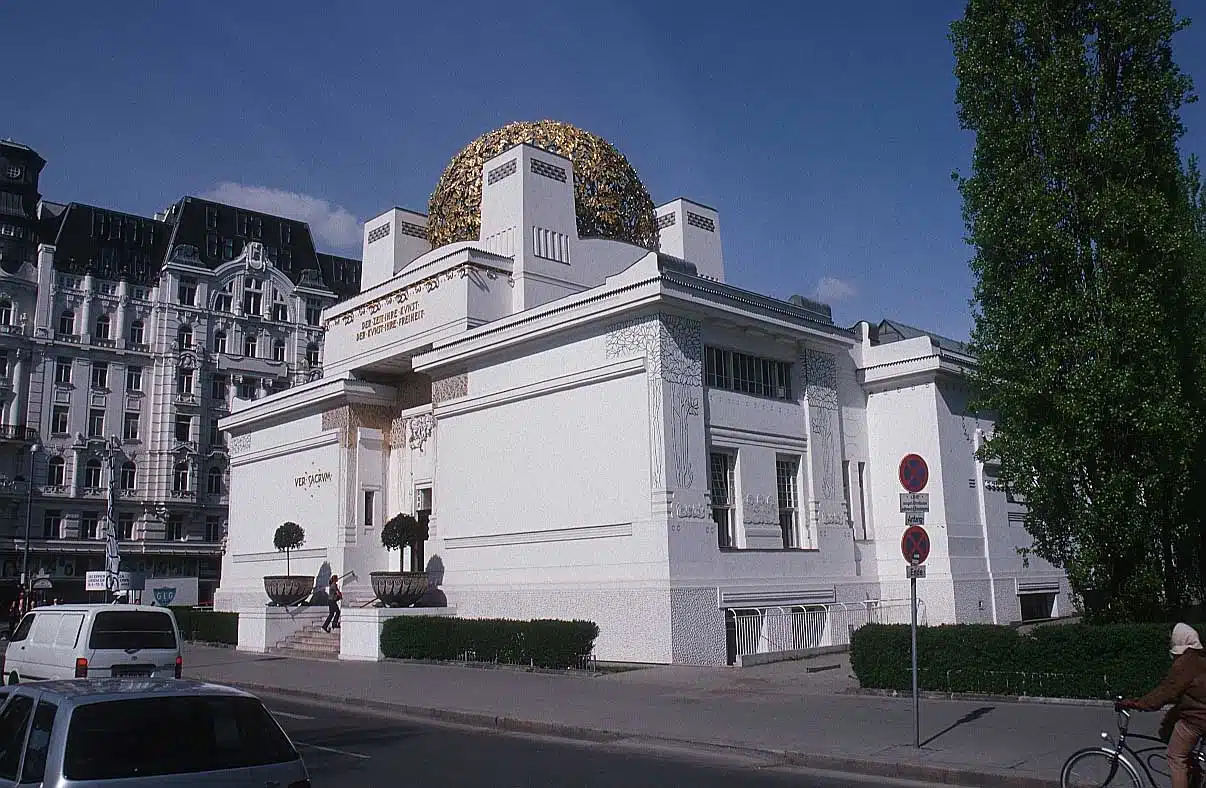
The Secession, with its dome of gilded laurel leaves, was built in 1897 and 1898 for artists who broke away from the official art world. In the basement is Gustav Klimt’s Beethoven Frieze from 1902, while the main hall shows contemporary art. Next door, the Naschmarkt has food stalls and small restaurants. It closes on Sundays, and a flea market runs on Saturdays.
10. The Hundertwasserhaus and Kunst Haus Wien

In the Landstrasse district, the Hundertwasserhaus is a block of council flats designed by the artist Friedensreich Hundertwasser and finished in the 1980s. Look for the uneven lines, bright colours and trees growing on the terraces. People live here, so you can only view it from the street. A short walk away, Kunst Haus Wien shows a permanent collection of his work and reopened in 2024 after renovation.
11. The Prater and the Giant Ferris Wheel

The Prater was an imperial hunting ground until Emperor Joseph II opened it to the public in 1766. The Wurstelprater amusement park has rides, food stands and the Giant Ferris Wheel. Built in 1897 and famous from the film The Third Man, it turns slowly and gives wide views from its wooden cabins. Beyond it, the tree-lined Hauptallee suits walking and cycling. Take the U1 or U2 to Praterstern.
12. The Danube Canal, Danube Island and Danube Tower
The Danube Canal, at Schwedenplatz, is lined with street art, cafés and summer bars, and boats to Bratislava leave from here. Danube Island is a long, car-free strip for swimming, cycling and picnics. In Donaupark, the Danube Tower has a viewing platform and a revolving restaurant. Next to it, the Vienna International Centre is a major United Nations office; guided tours need photo ID.
When to visit Vienna
Late April to June and September to October bring mild weather and a full programme of opera and concerts. July and August are warm and busy, but you can swim at Danube Island and watch open-air films in front of City Hall. From mid-November to Christmas, markets fill the squares, with the largest outside City Hall. January and February are cold and quiet, and this is ball season. Opening times at palaces and gardens change by season.
Tips for planning your trip
Vienna International Airport has fast trains to Wien Mitte and Wien Hauptbahnhof, and direct trains run from Munich, Salzburg and Prague. The old centre is easy on foot, and the U-Bahn, trams and buses cover the rest; passes for 24, 48 or 72 hours save buying single tickets. Plan three days for the main sights, more if you add day trips to the Wachau Valley or by train to Budapest’s historical landmarks. Book Schönbrunn, the Spanish Riding School and the Opera ahead in high season. On a warm evening, try a Heuriger, a local wine tavern, in Grinzing. Most shops close on Sundays. Check your government’s current travel advice before you travel.
Questions about Vienna
How many days do you need in Vienna?
Three days covers the old centre, the Hofburg, Schönbrunn and the Belvedere. Add a day or two for museums, the Danube or a day trip.
Do I need to book Schönbrunn Palace in advance?
Palace tours run on timed tickets, and slots can sell out in summer and at weekends, so booking online is wise. The main gardens need no ticket.
Can you go inside the Hundertwasserhaus?
No, it is a residential building and the flats are private. To see Hundertwasser’s art indoors, visit Kunst Haus Wien nearby.


