Best Ancient Sites in Egypt: 11 Temples and Pyramids to Visit
This guide covers Egypt’s best ancient sites, from Giza and Saqqara near Cairo to Luxor, Kom Ombo and Abu Simbel in the south. They span almost 3,000 years of history, many still have carved and painted walls, and most lie close to the Nile, so you can link them on one trip.
Our photographers visited many of them, and you can download their shots in our free ancient ruins pictures. Here are 11 of the best ancient sites and temples in Egypt, with tips on visiting them.
1. Pyramids of Giza, Egypt
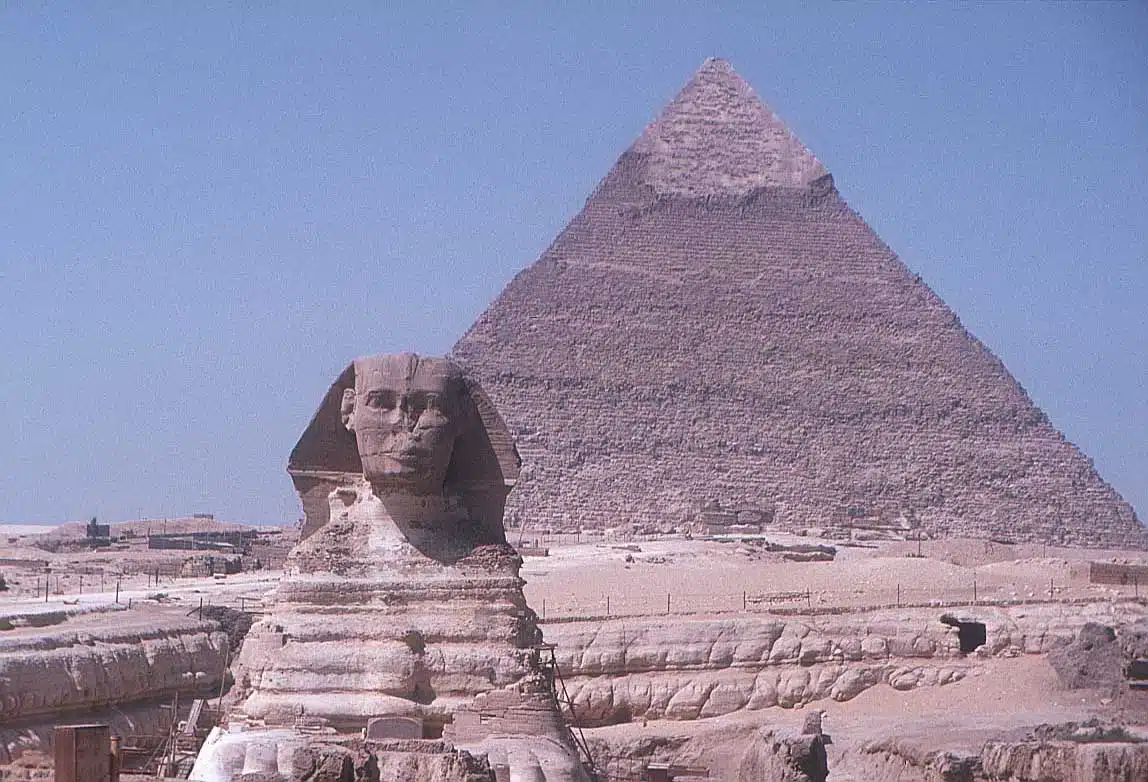
The pyramids of Khufu, Khafre and Menkaure, with the Great Sphinx below them, stand on a desert plateau at the edge of Cairo. The Great Pyramid is the only one of the Seven Wonders of the Ancient World still standing. In 2025 a new entrance system opened, with electric buses running between stops on the plateau. Going inside the Great Pyramid needs an extra ticket. Arrive at opening time to beat the heat and the tour groups. You can also add the Grand Egyptian Museum nearby, which officially opened in November 2025.
2. Saqqara, Egypt

Saqqara was the burial ground of Memphis, and its centrepiece is the Step Pyramid of Djoser, built around 2680 BC. It is the oldest pyramid in Egypt and one of the first large buildings made of cut stone. It reopened in 2020 after a restoration that lasted 14 years. The wider site also has finely carved tombs of officials and the Serapeum, a long gallery of huge stone coffins for the sacred Apis bulls. Saqqara lies south of Giza, so hire a driver and combine it with Memphis and Dahshur in one day.
3. Memphis, Egypt

Memphis was Egypt’s capital during the Old Kingdom, but little of the city survives above ground today. The open-air museum at Mit Rahina gathers the best finds in a shady garden. The highlight is a large alabaster sphinx with a calm, smooth face. A covered hall holds a fallen colossus of Ramesses II, which you look down on from a gallery. The visit takes about an hour, so it fits easily into a day trip to Saqqara.
4. Karnak Temple, Egypt

Karnak, on the edge of Luxor, is a vast complex of temples, chapels and gateways that pharaohs added to over many centuries, mainly for the god Amun. Its Great Hypostyle Hall has 134 giant columns, and rows of ram-headed sphinxes guard the main gate. In 2021 Egypt opened the restored Avenue of Sphinxes, an ancient road of about 2.7 km that links Karnak with Luxor Temple, and you can walk along it. Go early in the morning, allow at least three hours and carry water, as there is little shade.
5. Luxor Temple, Egypt
Luxor Temple stands in the centre of the modern city, close to the Nile. Built mostly by Amenhotep III and Ramesses II, it was the end point of the yearly Opet festival, when statues of the gods were carried here from Karnak. Look for the single obelisk at the entrance: its twin now stands in the Place de la Concorde in Paris. The temple stays open into the evening and is lit after dark, which makes a late visit cooler and calmer. Times change by season, so check before you go.
6. Kom Ombo, Egypt

Kom Ombo is a double temple on a bend of the Nile, north of Aswan. Built in the Ptolemaic period, it has two entrances and two sanctuaries side by side: one for Sobek, the crocodile god, and one for Haroeris, a form of Horus. Next to it, the Crocodile Museum, opened in 2012, shows mummified Nile crocodiles. Most Nile cruises between Luxor and Aswan stop here, and the stone looks its best near sunset.
7. Abu Simbel, Egypt

Ramesses II cut two temples into the rock at Abu Simbel, near the border with Sudan. The Great Temple has four seated statues of the king, each about 20 metres high, and the smaller one honours Queen Nefertari and the goddess Hathor. In the 1960s both were cut into blocks and moved higher to save them from Lake Nasser, as part of a UNESCO rescue campaign. Most visitors come on a long day trip by road from Aswan, or fly. On 22 February and 22 October the rising sun lights the inner sanctuary, so expect big crowds.
8. Valley of the Kings, Egypt
On the west bank of the Nile at Luxor, the New Kingdom pharaohs were buried in tombs cut deep into the hills. More than 60 tombs are known, and a selection is open at any time, many with painted walls that still look fresh. The standard ticket covers a set number of tombs, while famous ones such as Tutankhamun’s and Seti I’s need extra tickets. Open tombs change on a rota to protect them, so check which are open on the day. Go at opening time, before the heat builds.
9. Temple of Hatshepsut, Egypt
The temple of Hatshepsut at Deir el-Bahari rises in three wide terraces against a wall of cliffs, a short drive from the Valley of the Kings. Hatshepsut was one of the few women to rule Egypt as pharaoh, and the reliefs show a trading voyage to the land of Punt. The site is very exposed to the sun, so visit early or late. Combine it with the Colossi of Memnon and Medinet Habu on the same west bank day.
10. Temple of Horus, Edfu, Egypt
The Temple of Horus at Edfu is one of the best-preserved temples in Egypt. It was built under the Ptolemies between about 237 and 57 BC, and it still has its roof, its tall gateway and its dark inner sanctuary. The walls tell the story of the battle between Horus and Seth. Edfu lies between Luxor and Aswan and is a regular stop for Nile cruises, so it gets busy when several boats arrive together.
11. Philae, Egypt
The Temple of Isis at Philae was one of the last places where the old Egyptian gods were worshipped. When the Aswan dams flooded its island, the buildings were taken apart and rebuilt on nearby Agilkia Island in the 1970s. You can only get there by boat, a short ride from the landing at Shellal, south of Aswan. Agree the boat fare before you set off. An evening sound and light show also runs here.
Tips for visiting
The best time for Egypt’s ancient sites is from October to April, as summer in Luxor and Aswan is extremely hot. Many travellers spend two or three days in Cairo, then fly or take the train to Luxor or Aswan and travel between them on a Nile cruise. Tickets are sold at each site, and some extra areas, such as tomb interiors, need separate tickets. A licensed Egyptologist guide helps a lot. Wear a hat and comfortable shoes, carry water and dress modestly. Before you book, check your government’s current travel advice for Egypt.
Questions about Egypt’s ancient sites
How many days do you need to see Egypt’s ancient sites?
About 8 to 10 days lets you see Giza, Saqqara and Memphis, then Luxor, the Nile temples and Aswan with a day trip to Abu Simbel. With less time, focus on Cairo and Luxor.
Can you go inside the pyramids?
Yes. You can enter the Great Pyramid with an extra ticket, and other pyramids at Giza and Saqqara open at times. The passages are narrow, steep and warm, so skip them if you dislike tight spaces.
When is the Abu Simbel Sun Festival?
It takes place at sunrise on 22 February and 22 October each year, when light reaches the statues in the Great Temple’s sanctuary. Arrive very early, as the site is crowded on both days.


