12 Most Beautiful Cathedrals in Europe to Visit

Europe’s great cathedrals took centuries to build, and many still stand at the heart of their cities. This list covers Gothic giants, a Byzantine basilica, a Baroque organ church and small stone cathedrals on the Adriatic coast. Each is worth a trip for the art and light inside as much as the view from the square.
Most of these places come from our own trips, and you can browse them in our free church pictures. We also note the ticket and dress rules you need to know. Here are 12 of the most beautiful cathedrals in Europe, with tips on visiting them.
1. Notre-Dame de Paris, France
Notre-Dame stands on the Île de la Cité, an island in the Seine. The Gothic cathedral reopened in December 2024 after restoration following the 2019 fire, and the cleaned stone looks brighter than it has for generations. Look out for the rose windows and the stone chimeras on the towers. Entry is free, and a free online time slot helps you skip most of the queue. Climbing the towers is a separate paid visit that must be booked ahead.
2. St Mark’s Basilica, Venice, Italy
St Mark’s Basilica fills the east side of Piazza San Marco and has been Venice’s cathedral since 1807. It is Byzantine in style, with five domes and ceilings covered in gold mosaics. Behind the high altar is the Pala d’Oro, a gold altarpiece set with gems. A ticket with a time slot is now needed, so book ahead in summer. Cover shoulders and knees, and leave backpacks and large bags behind, as they are not allowed inside.
3. Florence Cathedral, Italy

Santa Maria del Fiore, known as the Duomo, is clad in white, green and pink marble. Its brick dome, designed by Filippo Brunelleschi in the 15th century, is still the largest masonry dome ever built. The cathedral is free to enter. To climb the 463 steps to the top of the dome you need a Brunelleschi Pass and a timed booking that cannot be changed. There is no lift.
4. St Vitus Cathedral, Prague, Czech Republic
St Vitus Cathedral rises inside Prague Castle. Building began in 1344 and only finished in 1929, so Gothic and later styles sit side by side. Inside are the silver tomb of St John of Nepomuk, the Wenceslas Chapel and a stained glass window designed by Alfons Mucha. You need a Prague Castle circuit ticket to visit the interior. Arrive when the castle opens to beat the tour groups.
5. Palma Cathedral, Mallorca, Spain
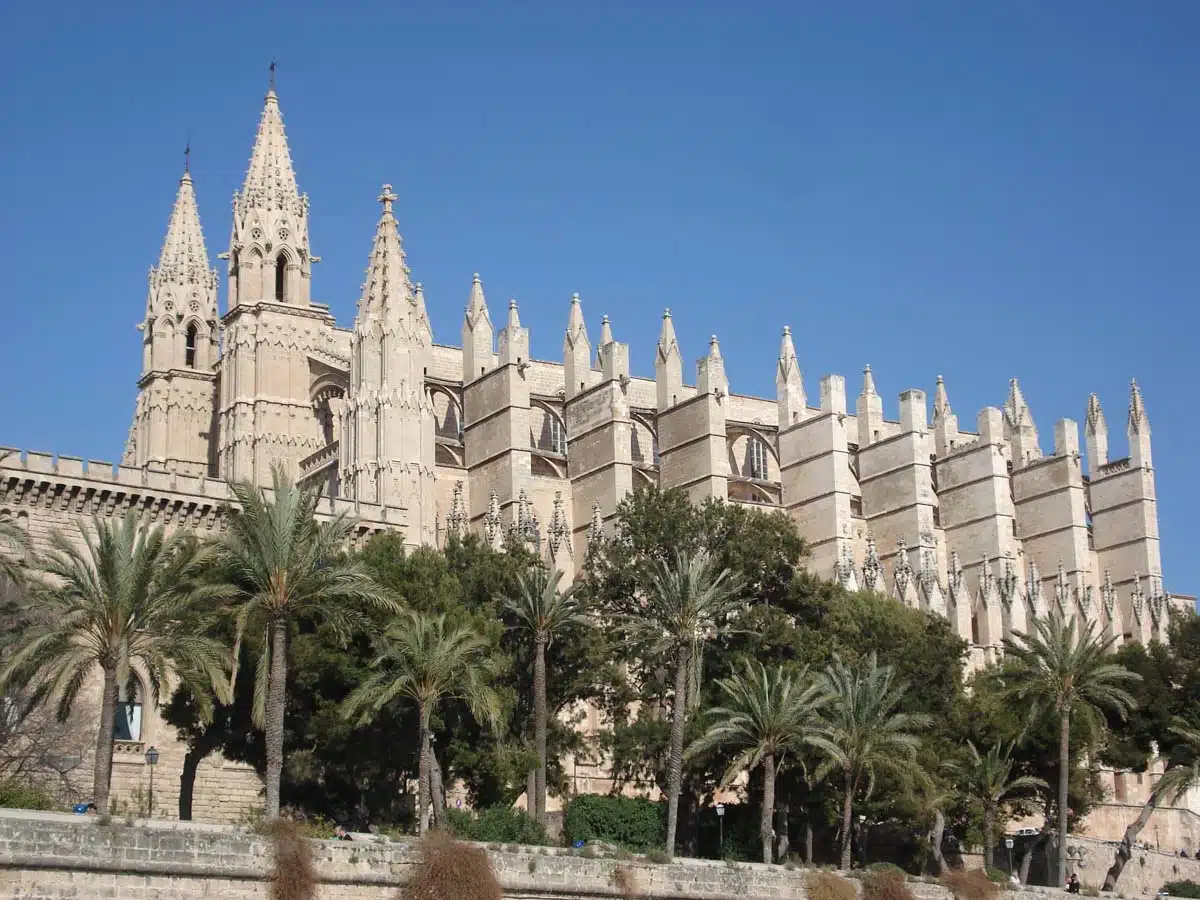
La Seu stands on the old sea wall above the Bay of Palma. Its Gothic nave is one of the tallest in Europe, and the rose window is among the largest anywhere. Antoni Gaudí reworked the interior in the early 20th century, and Miquel Barceló later created a ceramic chapel. A ticket is needed for tourist visits. On 2 February and 11 November, sunlight through the rose window draws a figure of eight inside.
6. Peterborough Cathedral, England
Peterborough Cathedral is one of the finest Norman buildings in England, and its West Front with three huge arches is unlike any other. Inside, look up at the painted wooden nave ceiling from the 13th century, a rare survivor. Katharine of Aragon, Henry VIII’s first wife, is buried here. Peterborough is under an hour by train from London King’s Cross, and the cathedral is a short walk from the station.
7. St Stephen’s Cathedral, Passau, Germany

Passau sits where the Inn and the Ilz meet the Danube. Its cathedral was rebuilt in Baroque style after a fire in 1662, and Italian artists filled the white interior with stucco and frescoes. The big draw is the largest cathedral organ in the world, with nearly 18,000 pipes. Short midday organ concerts run from May to October and need a ticket.
8. Riga Cathedral, Latvia

Riga Cathedral, the Doms, was founded in 1211 and is the largest medieval church in the Baltic states. It mixes Romanesque, Gothic and Baroque features around a quiet cloister. The organ, built in 1884, was once the largest in the world, and concerts are held through the year, so check the programme and buy tickets ahead. It stands on Dome Square, a good start for our things to do in Riga.
9. St Mark’s Cathedral, Korčula, Croatia

St Mark’s Cathedral crowns Korčula’s walled old town. It was built from local stone in the 15th and 16th centuries, mixing Gothic and Renaissance styles, and holds an altarpiece by Tintoretto. In summer you can climb the bell tower for views over the rooftops and the Pelješac Channel. Ferries and catamarans link the island with Split and Dubrovnik; see our things to do in Korčula.
10. Cathedral of St Lawrence, Trogir, Croatia
Trogir’s old town, on a small island near Split, is a UNESCO World Heritage Site. Its cathedral is known for the west portal carved by Master Radovan in 1240, with Adam and Eve standing on lions. Inside, the Renaissance Chapel of Blessed John of Trogir is a highlight of Croatian art. A ticket is needed, and you can climb the bell tower. Trogir is a short bus ride from Split; see our things to do in Trogir.
11. Cologne Cathedral, Germany
Cologne Cathedral is one of the largest Gothic churches in the world and a UNESCO World Heritage Site. Building started in 1248 and was only completed in 1880. Inside, the golden Shrine of the Three Kings sits behind the high altar. Since 1 July 2026 tourists need a ticket to enter, but worshippers still go in free through a separate entrance. Climbing the 533 steps of the south tower needs its own ticket. It stands next to the main railway station, so you can visit between trains.
12. Milan Cathedral, Italy
Milan’s Duomo took almost six centuries to finish, and its marble facade is covered in spires and statues. The best part of a visit is the roof terraces, where you walk among the spires with views across the city, reached by stairs or lift. Tickets are needed for both the cathedral and the terraces, and booking ahead saves time in busy months. Cover shoulders and knees.
Tips for visiting
Cathedrals are working churches, so tourist visits pause during Mass and on some feast days, and opening times change by season. Check the official website before you go. Covering shoulders and knees is required in Italy and expected elsewhere, so carry a light scarf. Go early or late in the day for smaller crowds and softer light through the stained glass. In summer, book timed tickets for St Mark’s, the Florence dome and the Notre-Dame towers well ahead. Before you travel, check your government’s current travel advice and entry rules.
Questions about Europe’s cathedrals
What is the most beautiful cathedral in Europe?
It depends on your taste. Notre-Dame and Cologne are classic Gothic, St Mark’s is famous for its gold mosaics and Florence has the most celebrated dome.
Do you have to pay to visit cathedrals in Europe?
Many are free to enter, including Notre-Dame and Florence, but St Mark’s, St Vitus, Milan and, since July 2026, Cologne need a ticket. Towers, domes and roof terraces usually cost extra.
What should I wear to visit a cathedral?
Cover your shoulders and knees, and men should remove hats. Staff at busy cathedrals, especially in Italy, can refuse entry to people in shorts or sleeveless tops.


